10 Best Cancer Hospitals in Mumbai (2026): Treatment, Costs, Free-Care Options & Supportive Care
Every year, more than 1,20,000 new patients register across the Tata Memorial Centre network alone — a sign of just how many families in and around Mumbai are, at this very moment, trying to find the best cancer hospital for someone they love.
If you are one of them, you already know the feeling: a diagnosis lands, and suddenly you are expected to compare oncology departments, treatment technologies, waiting times, and hospital bills, all while holding a family together. It is a lot to carry, and there is no single "right" hospital for everyone — the right choice depends on the type of cancer, the stage, your budget, and how much support you will need outside the hospital walls.
In this guide, you will find a clear, up-to-date list of Mumbai's leading private and government cancer hospitals, what each is known for, how free and subsidized treatment actually works in this city, and what complementary, supportive care can look like once hospital treatment begins — without adding to the confusion.
This guide is written by Dr. Hemant Kadam (BAMS), who works closely with oncology teams and cancer patients across India on complementary Ayurvedic supportive care, and medically reviewed by Dr. Farah Zariwala (BHMS).
How to Choose the Right Cancer Hospital in Mumbai
Mumbai has one of the densest concentrations of oncology care in India, which is genuinely good news — but it also means the list of "top" hospitals can feel overwhelming. Narrowing it down comes down to a handful of practical questions rather than reputation alone.

A cancer hospital is "right" for you when it matches three things: the specific cancer type and stage you are dealing with, the treatment technology and specialist experience required for that cancer, and your realistic budget or eligibility for government schemes. Most families weigh these alongside how far the hospital is from home, since cancer treatment usually means dozens of visits over several months.
1. Type and stage of cancer
Some hospitals are known for particular cancers — head and neck, blood cancers, breast, or paediatric oncology — because their surgeons and equipment are built around that specialisation. Ask directly whether the hospital's oncology team regularly treats your specific cancer type.
2. Technology and multidisciplinary teams
Look for hospitals offering the full range relevant to your case — surgical oncology, medical oncology (chemotherapy), radiation oncology, and increasingly, robotic surgery or advanced imaging such as PET-CT. A tumour board that reviews each case across specialities generally leads to better-coordinated treatment plans.
3. Cost and financial support
Private hospitals in Mumbai vary widely in cost, while government and government-aided hospitals offer free or heavily subsidised treatment to eligible patients. Ask early about Ayushman Bharat (PM-JAY), MJPJAY, hospital welfare funds, or NGO support — most billing departments can tell you your eligibility in one conversation.
4. Follow-up and supportive care
Cancer care does not end when active treatment does. Hospitals with structured counselling, nutrition support, palliative care and rehabilitation tend to see better patient experiences through and after treatment.
Top Private Cancer Hospitals in Mumbai
These multi-specialty and dedicated oncology centres are consistently named among Mumbai's leading private cancer care providers, based on their infrastructure, specialist teams and treatment breadth.
Mumbai's top private cancer hospitals include Kokilaben Dhirubhai Ambani Hospital, Nanavati Max Super Speciality Hospital, Jaslok Hospital, P.D. Hinduja Hospital, Lilavati Hospital, Fortis Hospital Mulund, HCG Cancer Centre and Wockhardt Hospitals. Each offers chemotherapy, radiation therapy and surgical oncology, with several offering robotic surgery and advanced imaging.

- Kokilaben Dhirubhai Ambani Hospital (Andheri) — established 2010; known for advanced imaging, a structured genetic risk-assessment programme for hereditary cancers, and proton therapy investment.
- Nanavati Max Super Speciality Hospital (Vile Parle) — a dedicated cancer centre offering chemotherapy, radiation, targeted therapy and immunotherapy, including nanotechnology-based targeted treatment.
- Jaslok Hospital and Research Centre (Peddar Road) — established 1973; multidisciplinary oncology programme with Gamma Knife and PET-CT diagnostics, and a long-standing research focus.
- P.D. Hinduja Hospital and Medical Research Centre (Mahim) — comprehensive oncology services with an active research and clinical-trials programme.
- Lilavati Hospital and Research Centre (Bandra) — full-spectrum oncology care within a large multi-specialty hospital.
- Fortis Hospital, Mulund — dedicated cancer institute with medical, surgical and radiation oncology under one roof.
- HCG Cancer Centre, Mumbai — part of a dedicated national oncology chain, focused exclusively on cancer diagnosis and treatment.
- Wockhardt Hospitals, Mumbai Central — multi-specialty hospital with an established oncology department.
- Breach Candy Hospital and S. L. Raheja Fortis Hospital — known respectively for broad specialist access and specific surgical strengths such as ocular oncology.
Costs and available technology change year to year, so always confirm current pricing, empanelment status and specialist availability directly with the hospital before finalising a decision.
Government and Free Cancer Hospitals in Mumbai
Cost is often the biggest barrier to timely cancer treatment, and Mumbai is fortunate to have a strong public oncology network built around one of Asia's largest dedicated cancer centres.
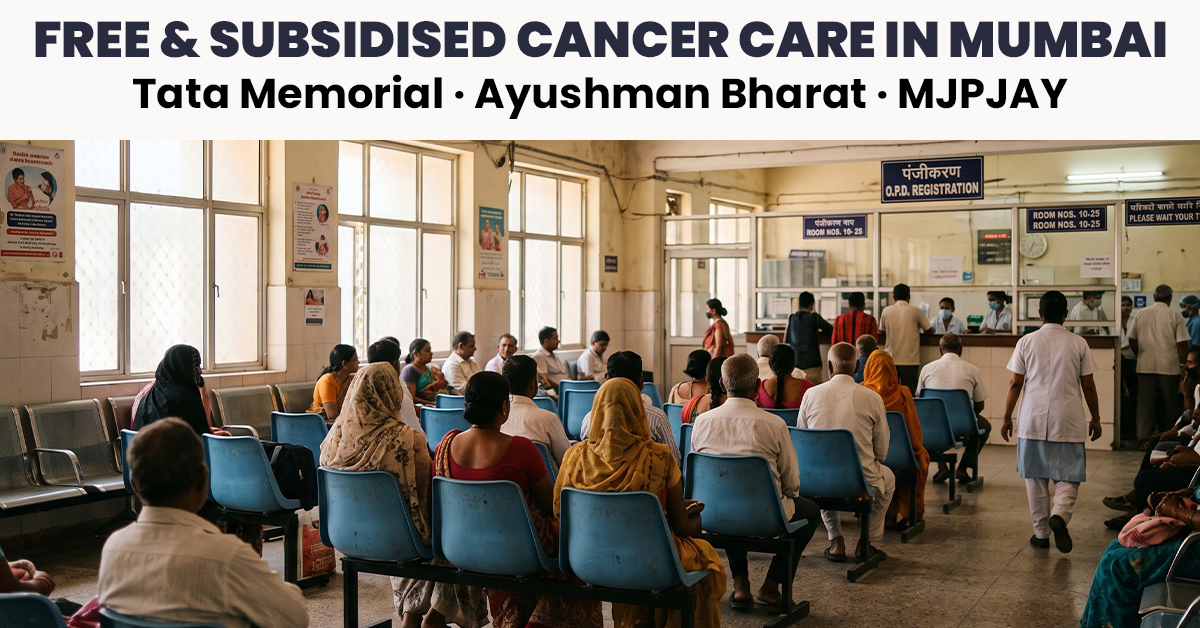
Tata Memorial Hospital in Parel is Mumbai's leading free and subsidised cancer treatment centre, run under India's Department of Atomic Energy. Roughly 60% of its patients receive free or nominal-cost care, supported by schemes such as Ayushman Bharat (PM-JAY). BMC-run hospitals — KEM, Sion, Sir J.J. and Cooper — also treat cancer patients at subsidised, government rates.
Tata Memorial Hospital, Parel
Tata Memorial is India's oldest and largest dedicated cancer centre, registering well over a hundred thousand new patients a year across its network. Its "No Charges" category gives zero-cost status for consultations, tests and bed stays to patients assessed as unable to pay, and it was the first hospital in India to start a bone marrow transplant unit.
BMC and government-aided hospitals
KEM Hospital, Sir J.J. Hospital, Sion Hospital and Cooper Hospital are long-standing, government-aided teaching hospitals that provide cancer diagnosis and treatment at subsidised municipal rates, alongside broader multi-specialty care. In 2026, the BMC and Maharashtra government announced plans for three new dedicated government cancer hospitals in Mumbai, alongside expanded robotic surgery capacity at major municipal hospitals.
Schemes worth knowing about
- Ayushman Bharat (PM-JAY) — cashless coverage up to ₹5,00,000 per family per year at empanelled hospitals, including many cancer treatment packages.
- Mahatma Jyotiba Phule Jan Arogya Yojana (MJPJAY) — Maharashtra's state scheme covering cancer surgery, radiation, chemotherapy and key diagnostics for eligible domicile holders.
- Aapli Chikitsa Yojana — Maharashtra's relaunched scheme for low-cost diagnostics at municipal facilities.
Eligibility documentation (income proof, domicile certificate, Ayushman/MJPJAY card) is usually verified by a hospital's medical social worker or Arogya Mitra coordinator — it is worth doing this in your very first visit.
Understanding Cancer Treatment Costs in Mumbai
Treatment cost in Mumbai varies enormously depending on cancer type, stage, hospital, and whether surgery, radiation, chemotherapy or a combination is needed.
Cancer treatment costs in Mumbai range from fully free (at Tata Memorial's No Charges category or BMC hospitals under government schemes) to several lakhs of rupees at private hospitals for advanced therapies like proton beam treatment or bone marrow transplants. Government schemes, hospital welfare funds and medical crowdfunding are the three main ways families bridge this gap.
- Government schemes: Ayushman Bharat and MJPJAY cover a defined list of procedures at empanelled hospitals, often at zero direct cost to eligible families.
- Hospital welfare and charitable funds: many private and trust-run hospitals maintain patient welfare funds for partial cost support — ask the hospital's medical social work or billing department directly.
- Medical crowdfunding and NGOs: platforms and cancer-focused NGOs can help bridge gaps for patients who do not qualify for government schemes but cannot afford private rates.
Whatever hospital you choose, ask for a written cost estimate covering the full treatment protocol — surgery, chemotherapy cycles, radiation sessions and follow-up scans — rather than just the first procedure, so there are no surprises later.
Supportive Care Alongside Hospital Treatment
Choosing a hospital is the first decision, not the only one. Most patients and caregivers quickly discover that hospital treatment addresses the cancer itself, while day-to-day issues — fatigue, appetite loss, nausea, disrupted sleep and general immunity — often need to be managed separately, in consultation with the treating oncologist.

Complementary or supportive care in oncology refers to approaches used alongside — never instead of — conventional cancer treatment, aimed at managing side effects and supporting overall wellbeing during chemotherapy, radiation or post-surgical recovery. It works by supporting the body's general resilience through nutrition, rest and, for some patients, adjunct formulations discussed with their oncologist.
This is the space Health Reactive India works in. Body Revival is an AYUSH-registered, nine-herb Ayurvedic liquid formulation manufactured under ISO/GMP-certified conditions, used by patients as complementary support alongside their prescribed oncology treatment — not as a substitute for it. Over three decades, Health Reactive has supported more than 1,00,000 patients in this complementary capacity.
For breast cancer patients specifically, Health Reactive's formulation has been studied in a registered clinical trial (CTRI/2023/11/059465) — a 44-patient, 12-week, open-label study in post-surgical breast cancer patients, conducted at J. B. Roy State Ayurvedic Medical College & Hospital, Kolkata, and completed in November 2024. It is important to be transparent about scope: this is a single trial, not yet peer-reviewed, and specific to post-surgical breast cancer care — it should not be read as evidence for other cancer types, and any decision to use it should be made in conversation with your treating oncologist.
If you are exploring complementary support for a loved one currently in cancer treatment, our team can walk you through how Body Revival fits alongside a hospital treatment plan.
A note from our clinical team
"In three decades of working alongside cancer patients and their families, the single biggest shift we've seen is families realising that supportive care isn't a replacement decision — it's an addition to the treatment plan their oncologist has already built. The families who do best are the ones who loop their oncologist into every complementary step, not the ones who go around them." — Dr. Hemant Kadam, BAMS, Health Reactive India
Key Takeaways
Mumbai offers some of India's strongest cancer care options, from research-led government institutions like Tata Memorial to specialised private centres like Kokilaben, Nanavati Max and Jaslok. Your right choice depends on cancer type, stage, budget and eligibility for schemes like Ayushman Bharat and MJPJAY. Whichever hospital you choose, ask early about costs, financial assistance and follow-up support — and if you are looking for complementary, supportive care to use alongside your treatment plan, discuss it openly with your oncologist first.
Looking for complementary support during cancer treatment? Book a Free Consultation with Health Reactive India
About the Author
Dr. Hemant Kadam (BAMS) works with Health Reactive India on complementary Ayurvedic supportive care for patients undergoing conventional cancer treatment, in coordination with oncology teams across India.
Medically Reviewed by Dr. Farah Zariwala (BHMS).
Frequently Asked Questions
Tata Memorial Hospital in Parel is Mumbai's primary free and subsidised cancer treatment centre, with a dedicated "No Charges" category for patients assessed as unable to pay, alongside BMC-run hospitals like KEM, Sion and Sir J.J.
Eligibility is usually assessed through income documentation and domicile proof, verified by a hospital's medical social worker, or through government scheme cards such as Ayushman Bharat (PM-JAY) or MJPJAY.
Complementary Ayurvedic formulations like Body Revival are designed to be used alongside—never instead of—conventional oncology treatment, and any such addition should always be discussed with your treating oncologist first.
Kokilaben Dhirubhai Ambani Hospital (proton therapy investment), Nanavati Max (nanotechnology-based targeted therapy) and Jaslok Hospital (Gamma Knife) are among those known for advanced oncology technology in Mumbai.