12 Warning Signs: Cancer Symptoms Early Stage in Women, Men, Children and More (2026)
Written by Dr. Hemant Kadam, BAMS | Medically reviewed by Dr. Farah Zariwala, BHMS (10+ years in Ayurveda and Homeopathy)
Published: 24 November 2026 | Last updated: 24 November 2026
|
MEDICAL DISCLAIMER This article is for education only. It cannot diagnose cancer or replace a doctor's examination. Ayurvedic supportive care does not treat or cure cancer. If you notice any symptom described here, see a qualified doctor or oncologist first. |
Most early cancers do not hurt. Many cause no symptoms at all. That is why cancer symptoms early stage are easy to miss, and why any unexplained change that lasts about two weeks deserves a doctor's attention.
Perhaps you noticed a lump, a mouth sore that will not heal, or weight loss you cannot explain. You may feel worried but unsure if it is serious. Searching online often adds fear instead of clarity.
In this guide, you will discover the 12 most common early warning signs, how they differ in women, men and children, and which symptoms matter in the stomach, mouth, skin and breast — without medical jargon or panic. Most of these symptoms have non-cancer causes. Still, an early check gives you the best chance of timely care.
Dr. Hemant Kadam (BAMS) wrote this guide. Dr. Farah Zariwala (BHMS), who has more than 10 years of experience in Ayurveda and Homeopathy, reviewed it. Health Reactive is a 30-year-old company that has supported more than 1,00,000 patients with complementary supportive care alongside conventional treatment.
|
KEY TAKEAWAYS
|
Cancer Symptoms Early Stage: What Should Everyone Know?
Early cancer often stays quiet. According to the National Cancer Institute (NCI), symptoms depend on where the tumour grows, how large it is and how much it affects nearby organs or tissues. Cancers of the pancreas or ovary, for example, may give only vague signals until they advance. Knowing the general pattern helps you decide when to act.
|
QUICK ANSWER Early stage cancer symptoms are body changes caused by a small tumour. They include unexplained weight loss, lasting fatigue, lumps, unusual bleeding and sores that do not heal. Most have non-cancer causes. A change that lasts about two weeks needs a doctor's review. |
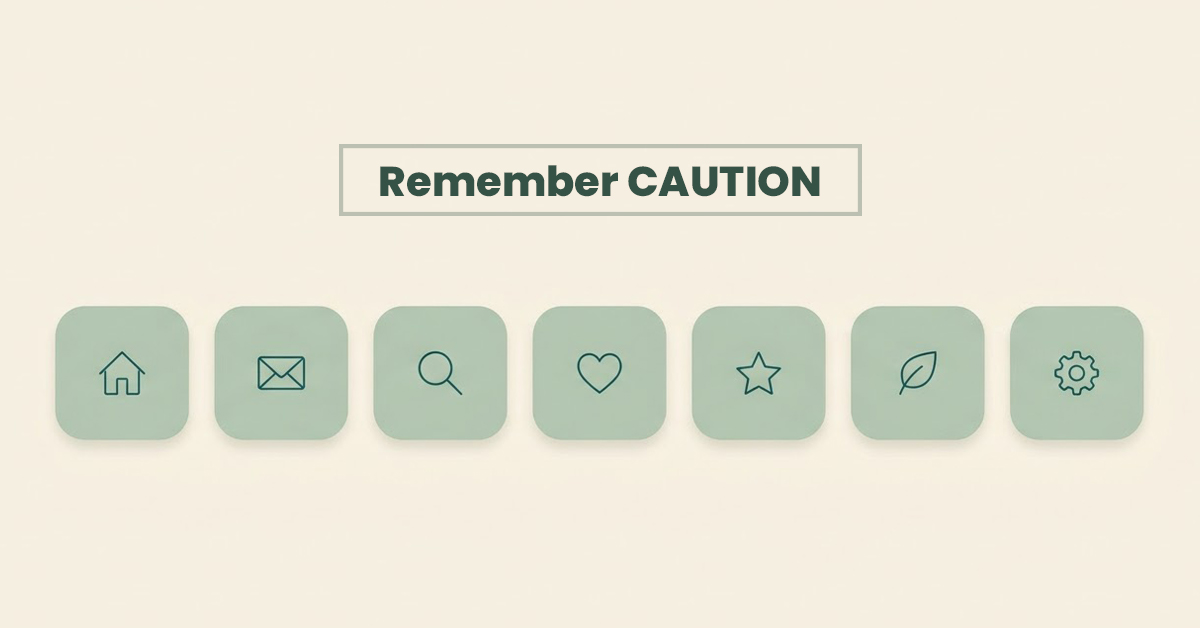
The American Cancer Society (ACS) uses the word CAUTION to help people remember seven warning signs. These are a change in bowel or bladder habits, a sore that does not heal, unusual bleeding or discharge, a thickening or lump, indigestion or trouble swallowing, an obvious change in a wart or mole, and a nagging cough or hoarseness (American Cancer Society, cancer.org).
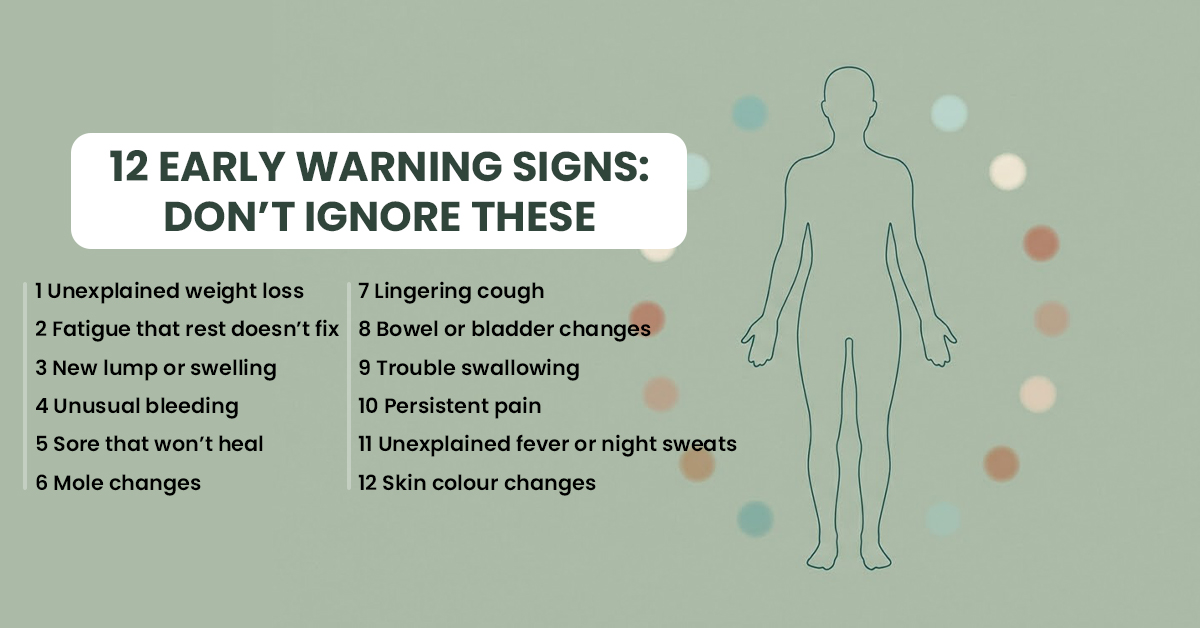
The 12 early warning signs of cancer
No single sign proves cancer. Look for changes that are new, lasting and getting worse.
- Unexplained weight loss. Losing weight without dieting or more exercise can be an early signal, especially with loss of appetite.
- Fatigue that rest does not fix. Extreme tiredness can occur when cancer affects blood counts or uses the body's energy.
- A new lump or swelling. Lumps in the breast, neck, armpit, groin or testicle should always be checked.
- Unusual bleeding or discharge. This includes blood in stool, urine or cough, and vaginal bleeding after menopause or between periods.
- A sore that does not heal. Mouth, skin and genital sores that last more than two to three weeks need review.
- Changes in a mole or skin spot. Watch for new size, colour, shape or bleeding.
- A cough or hoarseness that lingers. A voice change or cough lasting several weeks is worth checking, especially in smokers and tobacco users.
- Changes in bowel or bladder habits. Lasting constipation, diarrhoea, pain or difficulty passing urine can be warning signs.
- Trouble swallowing or constant indigestion. Food that sticks, or heartburn that does not settle, needs evaluation.
- Persistent pain with no clear cause. New back, bone or headache pain that keeps returning should be examined.
- Unexplained fever or night sweats. Repeated fevers without infection can occur in blood and lymph cancers.
- Skin colour changes. Yellow skin or eyes, or new darkening, redness or itching, may point to liver or skin problems.
Why do early symptoms get ignored?
Early signs are mild and look like everyday problems. A cough seems like a cold. Fatigue seems like stress. Bloating seems like diet. NCI notes that these symptoms are most often caused by illness, injury, benign tumours or other problems. That is true, and it is exactly why a short check is worth doing.
Why does timing matter?
The World Health Organization (WHO) states that detecting cancer early improves the chance of successful treatment. WHO estimates that cancer caused about 9.7 million deaths worldwide in 2022 (WHO, 2024). Early attention does not mean panic. It means you let a doctor rule cancer in or out.
What does "early stage" actually mean?
Doctors describe how far a cancer has grown and spread using stages. Early stage usually means the cancer is small and still limited to where it began. At this point, treatment options are often wider and recovery outcomes are generally better. Your oncologist assigns the exact stage after tests. A symptom alone cannot tell you the stage.
Some people find cancer by chance during a routine check or scan. Others notice a change at home. Both routes lead to the same next step: a proper medical evaluation.
Sources: National Cancer Institute (cancer.gov); American Cancer Society (cancer.org); World Health Organization.
What Are the Early Cancer Symptoms in Women?
Cancers more common in women include breast, cervical, ovarian and endometrial (uterine) cancer. Hormones, pregnancy and menopause can mask or mimic symptoms. Many women delay care because they are busy looking after others. Recognising the pattern early helps you act in time.
|
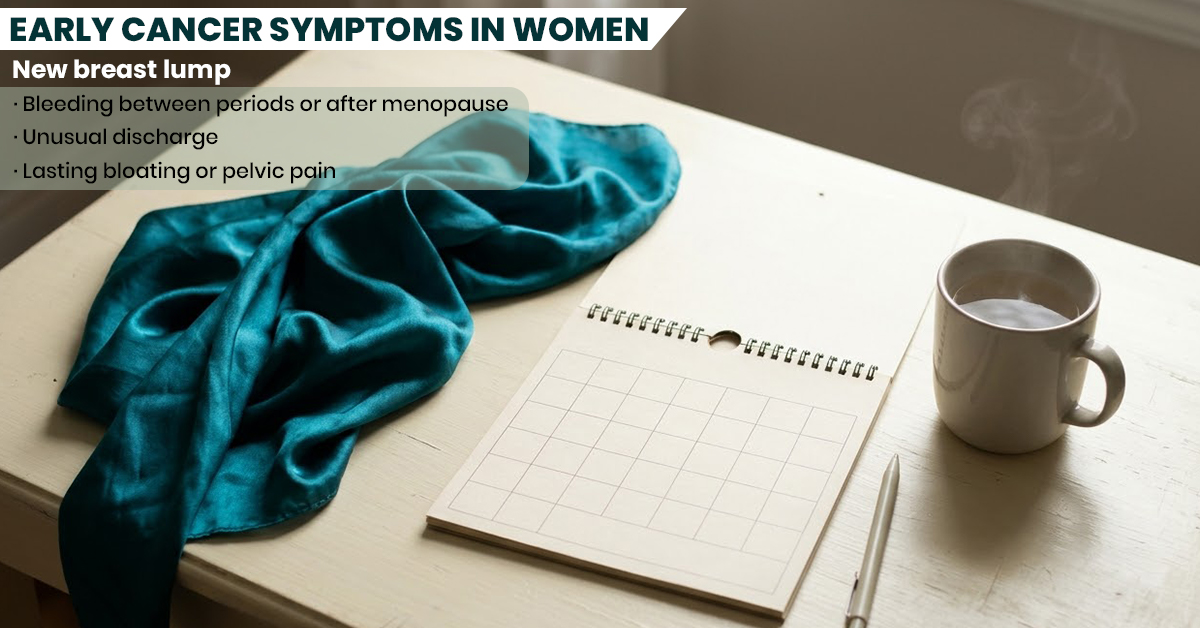
QUICK ANSWER Early cancer symptoms in women include a new breast lump, bleeding between periods or after menopause, unusual vaginal discharge, and lasting bloating or pelvic pain. These signs often have harmless causes. Any bleeding after menopause, or symptoms lasting more than two weeks, should be checked promptly. |
Breast changes
A painless lump is the classic sign. Skin dimpling, nipple changes and nipple discharge also matter. The full breast cancer checklist is in its own section below.
Cervical cancer signs
Early cervical cancer may cause no symptoms. Later signs include bleeding after sex, between periods or after menopause, watery or foul-smelling discharge, and pelvic pain. Regular cervical screening can find changes before symptoms appear. Ask your doctor which test suits your age.
Ovarian and uterine cancer signs
Ovarian cancer can cause bloating, pelvic or belly pain, feeling full quickly and a frequent urge to pass urine. These signs are easy to blame on digestion. If they are new and last for weeks, get them checked. Uterine cancer most often shows as abnormal bleeding, particularly after menopause.
Why do women often delay?
Many women put family first and treat new symptoms as hormones, stress or ageing. Heavy periods, bloating and tiredness are common, so cancer is rarely the first thought. Yet a change that is new for you, and lasts, is worth a short visit. A normal result brings real relief.
Women should also remember that unexplained weight loss, lasting fatigue and a new lump in the neck or armpit apply to every cancer type listed above.
Sources: National Cancer Institute (cancer.gov/types/cervical, /ovarian, /uterine); American Cancer Society.
What Are the Early Cancer Symptoms for Men?
Cancers common in men include prostate, lung, colorectal, mouth and testicular cancer. Men tend to wait longer before seeing a doctor. Tobacco and alcohol raise the risk for several of these cancers. Early awareness can shorten that delay.
|
QUICK ANSWER Early cancer symptoms in men include a lump or swelling in the testicle, a weak or interrupted urine stream, blood in urine or stool, a lasting cough, and a sore in the mouth that will not heal. Early prostate cancer often causes no symptoms at all. |
Testicular lump
A painless lump, swelling, heaviness or ache in the scrotum is the most common sign of testicular cancer. It is more common in younger men. Do not wait to see if it settles. Ask a doctor to examine it.
Urinary changes and the prostate
Early prostate cancer often has no symptoms. Later, men may notice a weak stream, frequent urination, difficulty starting, or blood in urine or semen. An enlarged prostate that is not cancer causes the same signs, so an examination is needed. Men over 50, or younger men with a family history, can ask their doctor about screening.
Lung, bowel and mouth
A cough that lasts weeks, coughing up blood, a change in bowel habit, or a mouth sore that does not heal should not be ignored. Smokers and tobacco chewers should be especially alert. Male breast cancer is rare, but a lump under the nipple needs checking.
Bowel changes in men and women
Colorectal cancer can begin with a lasting change in bowel habit, blood in the stool, belly cramps or unexplained tiredness from blood loss. Piles can cause bleeding too, but do not assume that is the cause. A doctor can tell the difference with a simple examination or colonoscopy.
Sources: National Cancer Institute (cancer.gov/types/testicular, /prostate); American Cancer Society.
What Are the Early Cancer Symptoms in Children?
Childhood cancer is rare, and it differs from adult cancer. Leukaemia, brain tumours and lymphomas are among the more common types in children. Symptoms are often mistaken for common childhood illnesses. Parents know their child best, so a lasting change in behaviour or health is worth reporting.
|
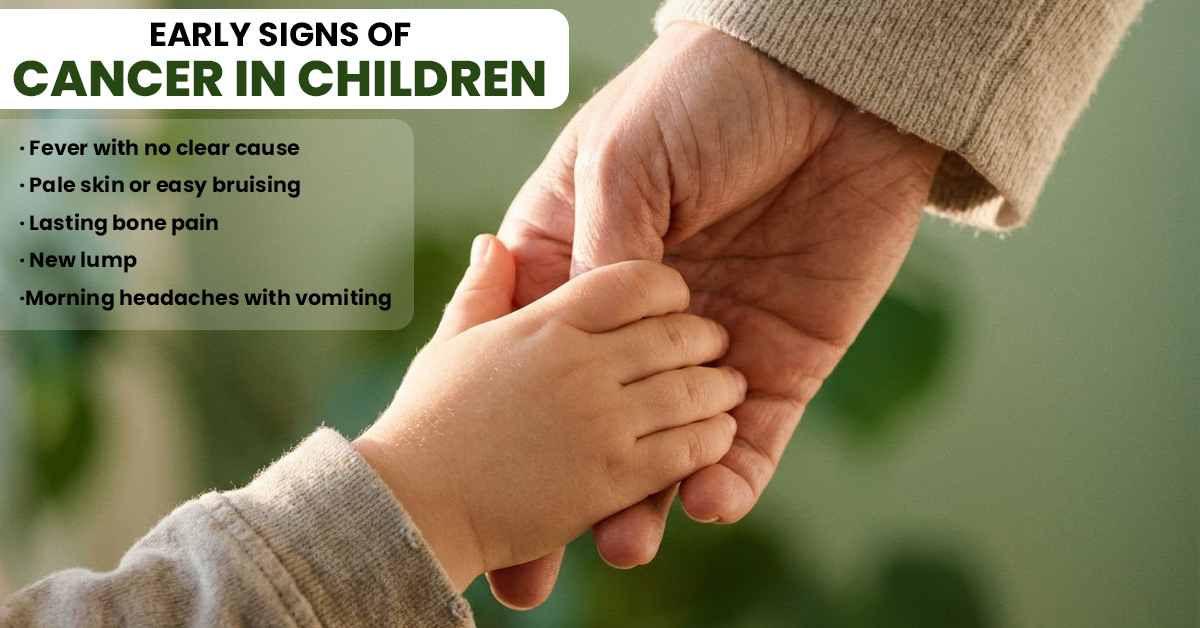
QUICK ANSWER Early cancer symptoms in children include a fever with no clear cause, frequent infections, unusual bruising or paleness, lasting bone or joint pain, a new lump, and morning headaches with vomiting. Most children with these signs do not have cancer. A paediatrician should evaluate any that persist. |
Signs parents should not ignore
- Unexplained fever or infections that keep returning
- Pale skin, unusual tiredness, easy bruising or small red spots
- Bone, joint or back pain that wakes the child at night or lasts for weeks
- A lump or swelling in the neck, belly, armpit or groin
- Headaches with vomiting, especially in the morning, or new balance or vision problems
- A white glow in the pupil in photographs, or a new squint
- Unexplained weight loss or loss of appetite
What to do: Take your child to a paediatrician or a paediatric oncologist without delay. Childhood cancers need specialist evaluation and treatment at a dedicated centre. Do not try home remedies or supplements while waiting for answers.
Source: National Cancer Institute, childhood cancers (cancer.gov/types/childhood-cancers).
What Are the Early Cancer Symptoms in the Stomach?
Stomach (gastric) cancer is hard to catch early. Its first signs look like ordinary acidity or indigestion. Long-term infection with Helicobacter pylori, a diet high in salted or smoked foods, and tobacco use raise the risk. Knowing which stomach symptoms are different helps you act sooner.
|
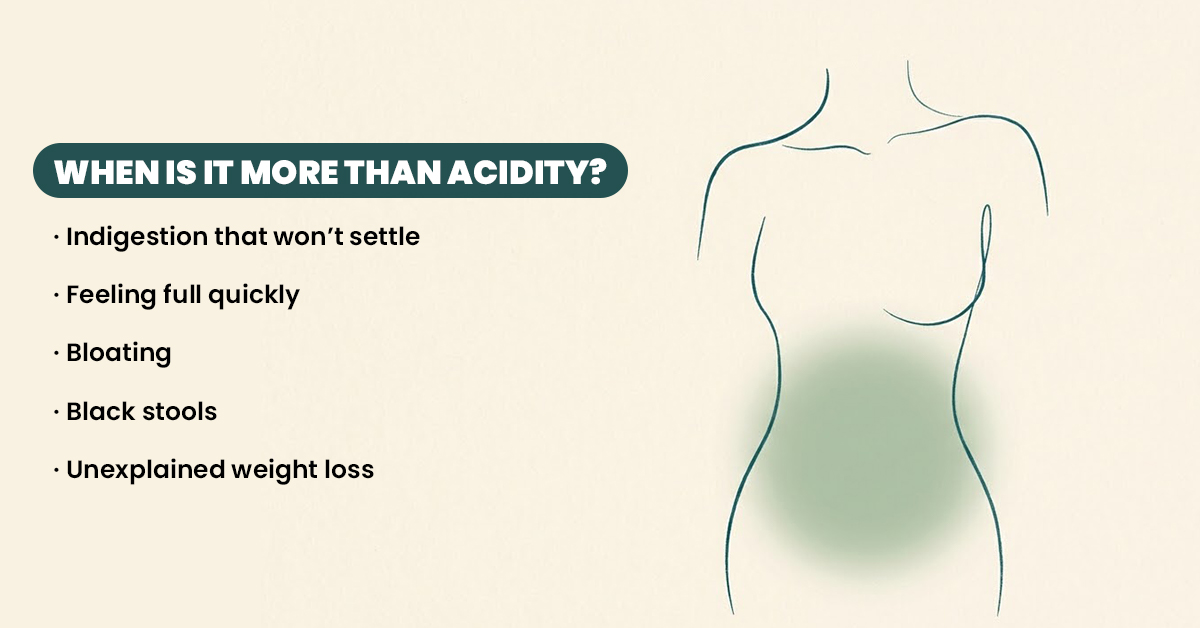
QUICK ANSWER Early stomach cancer symptoms include indigestion that does not settle, bloating after small meals, feeling full quickly, nausea, heartburn and loss of appetite. Later signs are vomiting, black stools and weight loss. Stomach pain that lasts more than two weeks should be examined by a doctor. |
When is it more than acidity?
Occasional acidity is common. See a doctor if indigestion is new, lasts weeks, comes with weight loss, or does not improve with usual medicines. Difficulty swallowing, repeated vomiting, black tarry stools or vomiting blood need prompt medical attention.
How is it checked?
Doctors usually use an upper gastrointestinal endoscopy to look inside the stomach and take a small tissue sample if needed. A biopsy is the only way to confirm cancer. Tests for H. pylori infection may also be advised.
Sources: National Cancer Institute (cancer.gov/types/stomach); American Cancer Society.
What Are the Early Cancer Symptoms in the Mouth?
Oral cancer is a major concern in India because tobacco chewing, smoking, betel quid with areca nut and alcohol are common risk factors. The mouth can be examined easily, so early changes are often visible. That makes regular self-checks especially valuable.
|
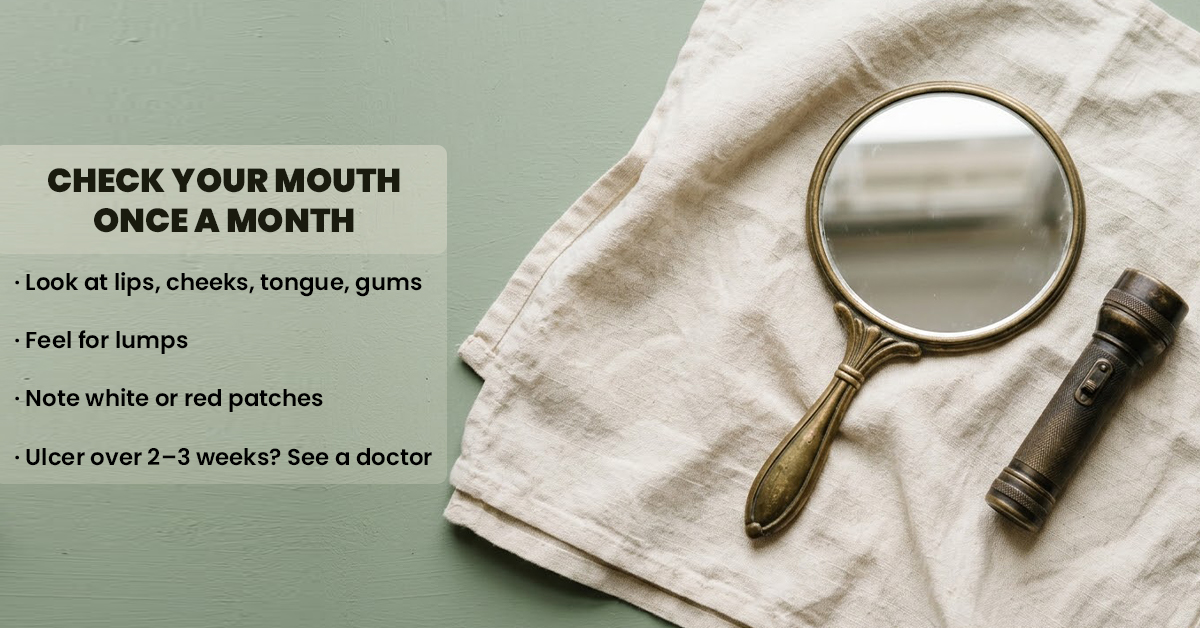
QUICK ANSWER Early mouth cancer symptoms include a sore or ulcer that does not heal in two to three weeks, white or red patches, a lump, numbness, pain when chewing or swallowing, and loose teeth. Any mouth change lasting more than two weeks needs a dentist or doctor's exam. |
How to check your mouth at home
Use a mirror and good light once a month. Look at the lips, cheeks, tongue, floor of the mouth and gums. Feel for lumps. Note any patch, ulcer or area that bleeds easily or feels rough or numb.
Who should be extra careful?
People who chew tobacco or areca nut, smoke, or drink alcohol regularly face higher risk. Ill-fitting dentures and sharp teeth that keep injuring one spot should also be corrected. If a sore stays beyond two to three weeks even after the cause is fixed, ask for a biopsy referral.
Sources: National Cancer Institute (cancer.gov/types/head-and-neck); American Cancer Society; WHO.
What Are the Early Cancer Symptoms on the Skin?
Skin cancer is visible, so it is often found early if you look. The main types are basal cell carcinoma, squamous cell carcinoma and melanoma. Melanoma is less common but more serious. Sun exposure is a key risk factor, yet skin cancer can also appear on areas the sun rarely touches.
|
QUICK ANSWER Early skin cancer symptoms include a new or changing mole, a pearly or waxy bump, a red scaly patch, and a sore that does not heal. Doctors use the ABCDE rule: asymmetry, irregular border, uneven colour, diameter over 6 mm, and evolving change. |
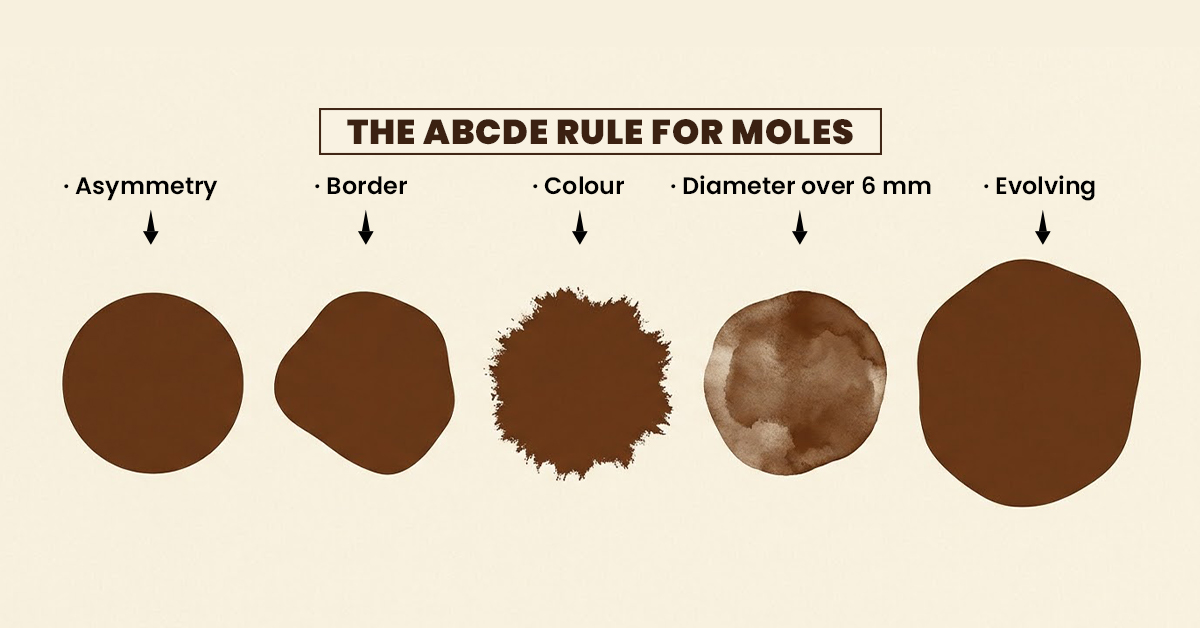
The ABCDE rule for moles
- A — Asymmetry: one half does not match the other.
- B — Border: edges are ragged, notched or blurred.
- C — Colour: shades of brown, black, red, white or blue in one spot.
- D — Diameter: larger than about 6 mm, roughly a pencil eraser.
- E — Evolving: any change in size, shape, colour, itching or bleeding.
Do not forget hidden areas
Check the soles, palms, between toes and under the nails. Melanoma can appear on these sites, including in people with darker skin. A dark streak under a nail that is new or widening should be examined by a dermatologist.
Sources: National Cancer Institute (cancer.gov/types/skin); American Academy of Dermatology.
What Are the Early Symptoms of Breast Cancer?
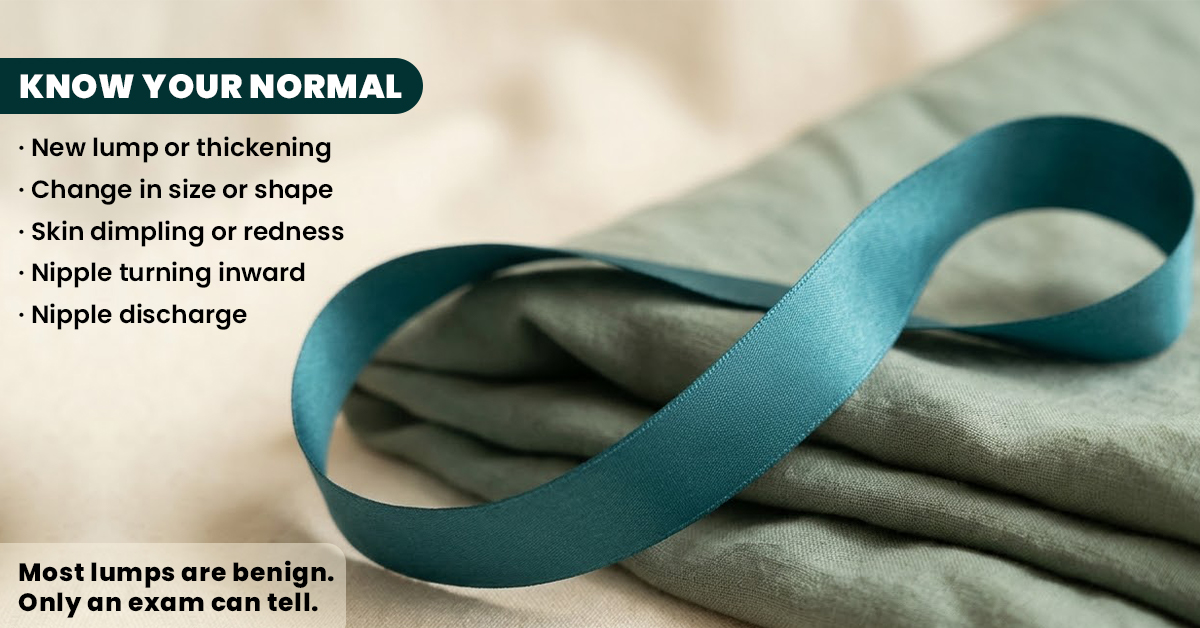
Breast cancer is the most common cancer in women worldwide. Most breast lumps turn out to be benign, but only an examination can tell. Learning how your breasts normally look and feel makes changes easier to spot. NCI lists a lump or thickening as a key sign.
|
QUICK ANSWER Early breast cancer symptoms include a new lump or thickening, a change in breast size or shape, skin dimpling or redness, a nipple turning inward, and nipple discharge. Early lumps are usually painless. Any new breast change should be examined by a doctor without waiting. |
What changes should you look for?
- A new lump or hard area in the breast or armpit
- Change in the size or shape of one breast
- Dimpling, puckering or an orange-peel texture on the skin
- Redness, scaling or thickening of the nipple or breast skin
- A nipple that turns inward, or discharge other than milk, especially bloody
- Persistent breast pain in one spot, although pain is less common early
Breast awareness and screening
Be aware of your own breasts and report changes quickly. Ask your doctor when to start clinical breast exams and mammography, since advice depends on age and family history. Men can also develop breast cancer, so a lump in a man's breast needs the same prompt check.
Sources: National Cancer Institute (cancer.gov/types/breast/symptoms); American Cancer Society.
Quick reference: early signs by group and body area
|
Group / area |
Early signs to watch |
Who to see first |
|
Women |
Breast lump, bleeding between periods or after menopause, lasting bloating |
Gynaecologist or breast clinic |
|
Men |
Testicular lump, weak urine stream, blood in urine or stool |
Urologist or physician |
|
Children |
Unexplained fever, pallor, bruising, bone pain, new lump |
Paediatrician / paediatric oncologist |
|
Stomach |
Lasting indigestion, early fullness, black stools, weight loss |
Gastroenterologist |
|
Mouth |
Ulcer or patch lasting over 2–3 weeks, numbness, lump |
Dentist or ENT / head and neck specialist |
|
Skin |
Changing mole, pearly bump, sore that does not heal |
Dermatologist |
|
Breast |
New lump, dimpling, nipple change or discharge |
Breast clinic or surgeon |
What Raises the Risk of Cancer, and What Can You Change?
Anyone can develop cancer, and having a risk factor does not mean you will. Some risks, such as age and family history, cannot be changed. Others can be reduced. Knowing both helps you decide how closely to watch for early symptoms.
|
QUICK ANSWER Cancer risk factors include tobacco use, heavy alcohol intake, certain infections, excess sun exposure, obesity, inactivity, age and family history. Tobacco is the largest preventable cause. You can lower risk by avoiding tobacco, limiting alcohol, staying active, protecting skin and keeping up with vaccines and screening. |
Risks you cannot change
Age is the biggest one, since cancer becomes more common as we grow older. A strong family history of breast, ovarian, bowel or prostate cancer also matters. If several close relatives had cancer at a young age, tell your doctor. You may be advised to begin screening earlier.
Risks you can change
- Tobacco and areca nut: smoking, chewing tobacco and betel quid with areca nut are linked to mouth, throat, lung and stomach cancers.
- Alcohol: regular heavy drinking raises the risk of mouth, throat, liver and breast cancer.
- Infections: Helicobacter pylori, hepatitis B and C and human papillomavirus (HPV) are linked to stomach, liver and cervical cancer. Vaccines and treatment can help.
- Sun and skin: repeated sunburn raises the risk of skin cancer. Seek shade and cover up in strong sun.
- Weight and activity: excess body weight and inactivity are linked with several cancers. Regular movement and a balanced diet help.
Small habits that support early detection
Do a monthly look at your skin and mouth. Know your breasts. Keep a note of any change that lasts. Attend scheduled check-ups and screening. Speak up early, because a short visit costs far less than a late diagnosis. These habits do not prevent every cancer, but they give you a better chance of catching one early.
Sources: World Health Organization (cancer fact sheet); National Cancer Institute (cancer.gov); American Cancer Society.
Cancer Symptoms Early Stage: What Should You Do Next?
Noticing a symptom is the first step. The next steps are simple. Do not self-diagnose, and do not wait for pain. Pain is often absent in early cancer. A prompt visit lets a doctor find the cause, whether it is cancer or something treatable and minor.
|
QUICK ANSWER If you notice early cancer symptoms, note when they started, see a doctor within about two weeks, and describe every change. Doctors may order an examination, imaging, blood tests or a biopsy. Only a biopsy or similar tissue test can confirm cancer. Do not delay for home remedies. |
A simple action plan
- Write it down. Note the symptom, the date it began, and whether it is changing.
- Book a check. See a general physician or the specialist in the table above.
- Ask what tests are needed. Imaging, blood tests, endoscopy or a biopsy may be advised.
- Share your history. Mention tobacco, alcohol, family history and past infections.
- Get a second opinion if unsure. It is a normal and sensible step for a serious diagnosis.
What about screening in India?
India's national programme for non-communicable diseases offers population-based screening for oral, breast and cervical cancer at public health facilities. Ask your nearest government health centre or your doctor about eligibility and local availability. Screening can find cancer before symptoms begin.
What not to do
Do not rely on unproven remedies, social media cures or herbal products in place of evaluation. Delay is the most costly mistake. If a cancer diagnosis is confirmed, treatment decisions belong with your oncologist.
Sources: National Cancer Institute (cancer.gov/about-cancer/diagnosis-staging/symptoms); Ministry of Health and Family Welfare, India (NP-NCD).
How Can Supportive Care Help Alongside Cancer Treatment?
Cancer treatment is decided by your oncologist. Many patients and families also look for complementary support to help them feel stronger during that journey. This may include nutrition guidance, gentle routines, and Ayurvedic supportive care. It works alongside conventional care, never instead of it.
|
QUICK ANSWER Supportive care means support for comfort and wellbeing during cancer treatment. Ayurvedic supportive care is complementary. It does not treat, cure or detect cancer. Patients should tell their oncologist about every product they use, because some herbs can interact with cancer medicines. |
Health Reactive has been working in Ayurveda for 30 years and has supported more than 1,00,000 patients with complementary supportive care. If you or someone you love has received a diagnosis, our team can talk through supportive-care options with you. We will always ask you to continue your oncologist's plan.
What Do Experts Say About Acting Early?
|
EXPERT GUIDANCE "If you have symptoms that last for a couple of weeks, it is important to see a doctor." — National Cancer Institute, Symptoms of Cancer, cancer.gov |
The NCI adds that cancer symptoms are most often caused by illness, injury, benign tumours or other problems. Both statements are true together. Most symptoms are not cancer, and the only way to know is to check.
Frequently Asked Questions
The first signs vary by cancer type. Common early signs include unexplained weight loss, lasting fatigue, a new lump, unusual bleeding, a sore that does not heal, and a cough or hoarseness that lingers. Many early cancers cause no symptoms, so screening matters.
Yes. Many cancers, including some stomach, ovarian, pancreatic and prostate cancers, may cause no noticeable symptoms early on. This is why recommended screening tests and regular check-ups are important, even when you feel well.
The National Cancer Institute advises seeing a doctor if symptoms last about two weeks. Do not wait if you notice heavy bleeding, a rapidly growing lump, black stools, trouble swallowing or coughing up blood. Seek care promptly.
Usually not. Early cancer often causes little or no pain. A painless lump or sore is still important. Waiting for pain before seeing a doctor can delay diagnosis.
Early signs in women may include a breast lump, bleeding between periods or after menopause, unusual discharge, lasting bloating and pelvic pain. Report any of these to a doctor, especially bleeding after menopause.
Men may notice a testicular lump, a weak urine stream, blood in urine or stool, a lasting cough, or a mouth sore that does not heal. Early prostate cancer often has no symptoms.
Signs include unexplained fever, frequent infections, paleness, easy bruising, lasting bone pain, new lumps and morning headaches with vomiting. Most are due to common illness, but a paediatrician should check persistent symptoms.
Doctors begin with an examination and history. They may order imaging, blood tests or endoscopy. A biopsy, where a tissue sample is examined under a microscope, is needed to confirm a cancer diagnosis.
No. Ayurveda does not cure cancer. Ayurvedic supportive care may be used as a complementary option alongside conventional treatment, with your oncologist's knowledge. It should never replace diagnosis or treatment.
You can book a free consultation with the Health Reactive team through the contact page. The consultation covers supportive-care questions. It does not diagnose cancer or replace an oncologist.
Cancer symptoms early stage are often subtle, painless and easy to explain away. Three points matter most. First, watch for changes that are new, lasting or worsening. Second, remember that women, men and children show different signs, and each body area has its own warning signals. Third, see a doctor if a change lasts about two weeks, and sooner for bleeding or a new lump. Early checks bring clarity, and clarity brings the best options.
Book Your Free Consultation
If you or a family member is dealing with a cancer diagnosis and wants to understand complementary supportive-care options, talk to our team. A free consultation will not diagnose cancer. It will help you plan supportive care alongside your oncologist's treatment.
Book a Free Consultation → healthreactive.com/contact-us
|
ABOUT THE AUTHOR AND REVIEWER Dr. Hemant Kadam (BAMS) is an Ayurvedic physician and author for Health Reactive. Dr. Farah Zariwala (BHMS) is the medical reviewer, with more than 10 years of experience in Ayurveda and Homeopathy. Health Reactive is an AYUSH-registered, ISO/GMP-certified company with 30 years of experience that has supported more than 1,00,000 patients. |