6 Essential Things to Know About Oral Cancer Treatment in Mumbai
India recorded 143,759 new oral cancer cases in 2022, the highest number of any country, according to GLOBOCAN data from the International Agency for Research on Cancer. If you or someone you love has just heard the words "oral cancer", two questions arrive at once. What happens next? Where should oral cancer treatment in Mumbai begin?
Searching online adds noise to fear. Hospital pages, forum posts, and bold promises compete for your attention. Many families lose precious weeks comparing claims when they could be acting on a diagnosis.
In this guide, you will discover how oral cancer is recognised and diagnosed, how surgery, radiation, and chemotherapy fit together, how to choose a treatment team in Mumbai, and how complementary supportive care can sit beside your oncologist's plan, without replacing it.
Dr. Hemant Kadam, BAMS, wrote this guide, and Dr. Farah Zariwala, BHMS, medically reviewed it. Author has 15+ years of experience in Ayurveda. Health Reactive has supported more than 1,00,000 patients since 1996 with complementary supportive care. We do not treat or cure cancer. Your treating oncologist leads your treatment.
Key Takeaways
- India has the world's highest number of oral cancer cases, and most are linked to tobacco and areca nut.
- A mouth ulcer, patch, or lump that lasts more than three weeks needs a doctor's examination.
- Surgery is usually the first treatment for oral cavity cancers. Radiation, chemotherapy, targeted therapy, and immunotherapy are added by stage and risk.
- A multidisciplinary tumour board should agree your plan. A second opinion is normal and should be quick.
- Complementary supportive care may sit beside standard treatment, never in place of it. Tell your oncologist about everything you take.
What Is Oral Cancer and What Are the Main Oral Cancer Types?
Oral cancer is not one single disease. Doctors group it by where it starts and by the type of cell involved. Oral cavity cancer covers the lips, floor of the mouth, oral tongue, inner cheek (buccal mucosa), gums, hard palate, and the retromolar trigone behind the last molar. Some studies also count the oropharynx, which sits behind the mouth. This matters because location decides the surgery, the radiation field, and the recovery.
Quick answer: Oral cancer is a malignant growth that starts in the lips or the lining of the mouth. It begins when abnormal cells multiply without control. Most oral cancers are squamous cell carcinomas. Doctors confirm the diagnosis with a biopsy, then stage the disease using examination and imaging scans.
Oral cancer types by site
- Oral tongue: the moving front two-thirds of the tongue. These cancers can affect speech and swallowing.
- Buccal mucosa and gums: the inner cheek and gum lining. Clinicians in India see these often in people who keep tobacco quids in the cheek.
- Floor of mouth and hard palate: less common sites, but close to important structures such as the jaw.
- Lip: often found early because it is visible. The National Cancer Institute's PDQ summary reports that early lip cancers are highly curable, with cure rates of 90% to 100% using surgery or radiation.
Oral cancer types by cell
Squamous cell carcinoma makes up most oral cancers. Rarer types include verrucous carcinoma, minor salivary gland cancers, and, very rarely, melanoma or lymphoma. Your pathology report names the exact type and grade, and your oncologist builds the plan around it.
How oral cancer differs from an ordinary mouth ulcer
Ordinary ulcers usually hurt, heal within one to two weeks, and often follow a bite or a hot drink. Cancerous ulcers tend to persist, feel firm or thickened at the edges, and may be painless at first. They often keep growing or bleed easily. When in doubt, wait no longer than three weeks before getting the sore examined.
Precancerous changes worth knowing
Some patches and conditions can come before cancer. White patches (leukoplakia), red patches (erythroplakia), and oral submucous fibrosis, which stiffens the cheeks and limits mouth opening, are well-known examples. A dentist or head and neck specialist should examine any of them. Not every patch becomes cancer, but every persistent patch deserves a check.
Oral cancer stages in plain language
Staging describes how far the cancer has grown. Early stages mean a smaller tumour with no spread to lymph nodes. Later stages mean a larger tumour, spread to neck lymph nodes, or spread to distant organs. Earlier stages are generally easier to treat with less extensive surgery, so early detection changes the options available to you.
Your doctor will also describe the grade, which shows how abnormal the cells look under the microscope, and the depth of invasion, which measures how deeply the tumour has grown into the tissue. Both details appear on the pathology report. Ask the team to explain each term in plain words.
How big is the problem in India?
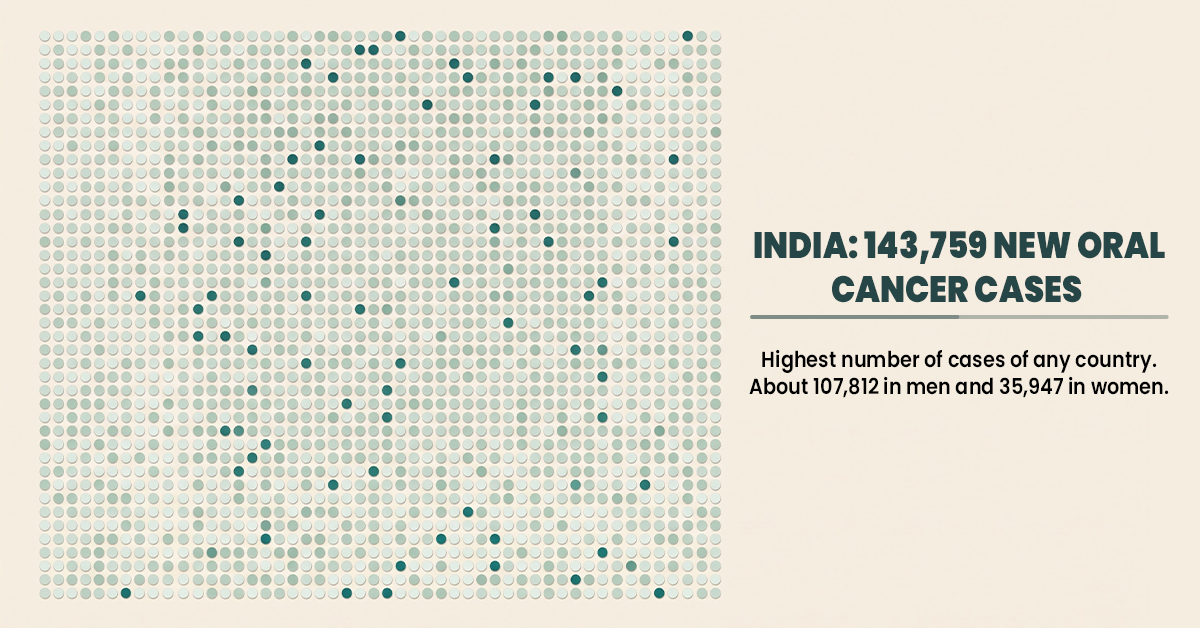
The World Cancer Research Fund lists India first for lip and oral cavity cancer in 2022, with 143,759 new cases. About 107,812 of those cases were in men and 35,947 in women. A GLOBOCAN-based analysis in ecancermedicalscience reports 79,979 deaths from oral cancer in India that year, 8.7% of all cancer deaths in the country.
What Causes Oral Cancer? Oral Cancer Causes and Risk Factors in India
Understanding oral cancer causes helps in two ways. It shows which risks you can change, and it explains why regular screening matters for adults of every age. Most risk factors build slowly over years, so a person may feel perfectly well while changes begin.
Quick answer: Tobacco and areca nut use cause most oral cancers in India. Together they account for roughly 70% to 80% of cases. Alcohol adds risk, especially alongside tobacco. Chronic irritation from sharp teeth or ill-fitting dentures can contribute. Stopping tobacco and areca nut lowers risk over time.
The ecancermedicalscience analysis of GLOBOCAN 2022 data attributes about 70% to 80% of Indian cases to tobacco and areca nut use. The NHS also lists heavy smoking and drinking as key risk factors for mouth cancer.
Common risk factors
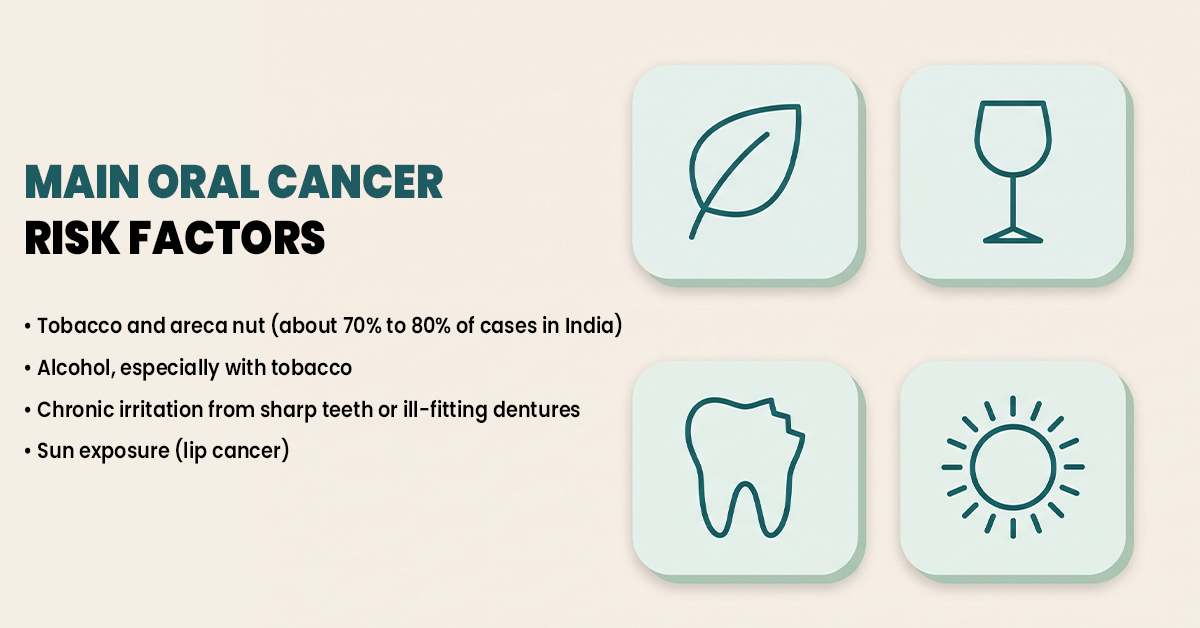
- Chewing tobacco and areca nut: gutka, khaini, zarda, and betel quid with tobacco.
- Smoking: cigarettes, bidis, and other smoked tobacco.
- Alcohol: risk rises further when combined with tobacco.
- Chronic irritation: sharp or broken teeth and poorly fitting dentures that rub the same spot for months.
- Sun exposure: a risk for lip cancer in people who work outdoors.
- HPV infection: linked mainly to cancers at the back of the throat (oropharynx), rather than the front of the mouth.
What you can do to lower your risk
- Stop all forms of tobacco and areca nut. Ask your doctor about cessation support.
- Limit or avoid alcohol.
- Visit a dentist every six months and ask for an oral cancer check.
- Check your own mouth monthly under good light. Look at the tongue, cheeks, gums, and floor of the mouth.
- Get sharp teeth and loose dentures corrected.
Myths and facts about oral cancer causes
- Myth: Only smokers get oral cancer. Fact: Chewed tobacco and areca nut are major causes in India, even in people who have never smoked.
- Myth: Smokeless tobacco is safer than cigarettes. Fact: Smokeless products sit directly against the lining of the mouth, which is where many oral cancers start.
- Myth: If it does not hurt, it is not serious. Fact: Early oral cancer is frequently painless.
- Myth: Oral cancer only affects older adults. Fact: Risk rises with age, but long-term chewing habits can lead to cancer in younger adults too.
Oral cancer causes also explain why men account for most cases in India, where tobacco use has historically been higher among men. Women are not immune, and chewing habits affect both.
What Are the Oral Cancer Symptoms and When Should You See a Doctor?
Early oral cancer symptoms are easy to miss because they are often painless. A small ulcer may look like a bite mark or a canker sore. That is why the three-week rule matters. It gives ordinary ulcers time to heal and flags the ones that do not.
Quick answer: Common oral cancer symptoms include a mouth ulcer that does not heal in three weeks, red or white patches, and a lump in the mouth or neck. Numbness and difficulty swallowing can also occur. Most mouth ulcers are harmless. Any sign lasting beyond three weeks needs a doctor's examination.

NHS guidance advises seeing a GP or dentist if sore mouth ulcers or patches have not healed within three weeks, particularly for people who smoke or drink heavily.
Symptoms to watch for
- A mouth ulcer or sore that does not heal within three weeks.
- Red or white patches on the tongue, cheek, or gums.
- A lump, thickening, or swelling in the mouth, jaw, or neck.
- Numbness, unexplained bleeding, or pain in the mouth or tongue.
- Difficulty chewing, swallowing, speaking, or opening the mouth fully.
- A tooth that becomes loose for no clear reason.
- Persistent hoarseness or sore throat, and unexplained weight loss.
Do not delay biopsy for home or herbal remedies. Trying a remedy for weeks before a diagnosis can let an early cancer advance. Get the sore examined first.
Who should get a regular oral cancer check?
Any adult who uses tobacco or areca nut in any form should have the mouth examined regularly, even without symptoms. The same advice applies to people who drink alcohol often, people with white or red patches, and people with limited mouth opening. A dentist can perform a quick visual and touch examination during a routine visit. Early detection is the single most useful step in oral cancer care.
What happens at the first medical visit
The doctor examines the mouth and neck. A biopsy takes a small tissue sample for the pathologist. Imaging such as CT, MRI, or PET-CT shows how far the disease has spread. The team then assigns a stage, usually using the TNM system, which describes the tumour size (T), lymph node involvement (N), and spread to other organs (M). Staging drives every treatment decision that follows.
How Is Oral Cancer Treated in India? Surgery, Radiation, Chemotherapy and More
Oral cancer treatment in India follows the same international principles as elsewhere. The plan depends on stage, site, the type of cell, and the patient's general health. A multidisciplinary tumour board, which brings together surgeons, radiation oncologists, medical oncologists, pathologists, and rehabilitation specialists, normally agrees the final plan.
Quick answer: Oral cancer treatment depends on stage, site, and overall health. Surgery is usually the first treatment for oral cavity cancers. Radiation or chemoradiation often follows surgery for higher-risk disease. Chemotherapy, targeted therapy, and immunotherapy help in advanced or recurrent cancer. A tumour board plans the combination.
Surgery
A published review of radiotherapy and chemotherapy in oral cancer notes that surgery is usually the mainstay of treatment for oral cavity squamous cell carcinoma. The surgeon removes the tumour with a margin of healthy tissue. Reconstructive surgery can then restore appearance and function, such as chewing and speech. Neck dissection removes lymph nodes where cancer cells may travel.
Radiation therapy
Radiation uses high-energy beams to destroy cancer cells. Doctors commonly give it after surgery when the pathology report shows higher-risk features. Primary radiation, with or without chemotherapy, is usually reserved for patients who cannot have surgery or whose cancer is better treated this way. A dental check before radiation is standard practice, because radiation affects the teeth and jaw.
Chemotherapy, targeted therapy, and immunotherapy
Chemotherapy may be combined with radiation (chemoradiation), given before surgery to shrink a tumour, or used for cancer that has spread. Targeted therapy drugs, such as cetuximab, attack specific features of cancer cells. Immunotherapy helps the immune system recognise cancer. According to the American Cancer Society, these systemic options are most relevant in advanced or recurrent disease.
Treatment options by stage
|
Stage |
Typical approach (American Cancer Society, drawing on NCI PDQ and NCCN) |
|
Stage 0 |
Surgery to remove abnormal tissue; radiation if it keeps returning. |
|
Stage I and II |
Surgery and/or radiation. Chemoradiation is another option. Radiation alone may be used first for some patients. |
|
Stage III and IVA |
Surgery, most often followed by radiation or chemoradiation. |
|
Stage IVB and IVC |
Usually chemotherapy, targeted therapy such as cetuximab, or both. |
|
Recurrent |
More surgery, radiation, chemotherapy, targeted therapy, immunotherapy, or a combination. |
Common side effects and how teams manage them
Every treatment has side effects, and good teams plan for them before treatment starts. After surgery, patients may have swelling, difficulty chewing, and temporary speech changes. Radiation can cause mouth sores, dry mouth, taste changes, and skin irritation in the treated area. Chemotherapy can cause tiredness, nausea, and a higher risk of infection.
Your team can reduce many of these problems with pain control, mouth-care routines, feeding support, and speech and swallowing exercises. Report new symptoms early rather than waiting for the next visit. Early help usually works better than late help.
Dental care before and after treatment
Oral cancer treatment affects the teeth, gums, and jaw. A dentist experienced in cancer care should examine you before radiation begins. Damaged or infected teeth may need removal first, because problems after radiation are harder to manage. After treatment, daily mouth care, fluoride, and regular dental visits protect against decay and jaw complications.
Understanding the goal of treatment
For most early and locally advanced oral cancers, the goal is to remove or destroy the cancer completely. Doctors call this curative intent. For cancers that have spread widely, the goal may shift to controlling the disease and protecting comfort and quality of life. Ask your oncologist which goal applies to you, and ask it again if your situation changes.
A Mumbai study that changed practice
A randomised trial from Tata Memorial Centre in Mumbai studied 596 patients with early-stage, node-negative oral cancer. Surgeons either removed the neck lymph nodes at the time of the main operation or waited and operated only if the disease returned in the neck. The results, published by D'Cruz and colleagues in the New England Journal of Medicine in 2015, showed 3-year overall survival of 80.0% with elective neck dissection, compared with 67.5% with the wait-and-watch approach.
This is a strong example of why the experience and protocol of your surgical team matter. It also shows that world-class oral cancer research happens in Mumbai itself.
Palliative care is part of good cancer care
Palliative care is a medical specialty focused on relieving symptoms such as pain, difficulty swallowing, and distress. It is not only for the end of life. Many patients receive it alongside curative treatment to feel more comfortable. Ask your hospital whether a palliative care or pain clinic team can support you from the start.
Follow-up after treatment
Oral cancer can return, so regular follow-up visits matter. Your team will schedule examinations, and sometimes scans, at set intervals. Keep every appointment, even when you feel well. If you notice a new ulcer, lump, or swelling between visits, call the team rather than waiting for your next date.
Rehabilitation after treatment
Recovery does not end when treatment ends. Many patients need speech and swallowing therapy, dental rehabilitation, nutrition support, and help with jaw movement. Ask your hospital which of these services it offers, and when they begin.
How Do You Choose Oral Cancer Treatment in Mumbai or Oral Cancer Treatment Near Me?
Mumbai has public, trust-run, and private hospitals that treat head and neck cancers. Tata Memorial Hospital in Parel and its sister centre ACTREC in Navi Mumbai are among the best known. This guide does not rank hospitals. It gives you a framework to compare any option, so you can decide with your family and your doctors.
Quick answer: To choose oral cancer treatment in Mumbai, look for a head and neck surgical oncologist and a multidisciplinary tumour board. Check access to radiation oncology, reconstructive surgery, dental care, and speech therapy. Ask about expected outcomes, costs, and second opinions. Do not delay treatment while comparing hospitals.
Questions to ask at your first consultation
- Who will lead my care, and how many oral cancer patients does this team treat each year?
- Will a tumour board review my case? Can I see the written plan?
- Which treatments do you recommend, and what are the alternatives?
- What side effects should I expect, and how will you manage them?
- Is reconstruction, dental care, and speech or swallowing therapy available on site?
- What is the estimated total cost, and what does it include?
- How soon can treatment start?
Documents to carry to every consultation
- The biopsy report and, if available, the pathology slides and blocks.
- All scan reports and the scan images on a disc or digital copy.
- A list of current medicines, supplements, and herbal products.
- Records of earlier illnesses, surgeries, and allergies.
- Photo identification and any health insurance or scheme documents.
Warning signs when comparing options
Be cautious if any provider promises a guaranteed cure, discourages you from seeking a second opinion, or asks you to stop standard treatment. Be equally careful with anyone who will not share a written plan or an itemised estimate. A trustworthy team explains the options, the risks, and the unknowns, and it respects your questions.
Getting a second opinion
A second opinion is normal in cancer care and does not offend a good team. Bring your biopsy report, imaging, and any pathology slides. Do not let the search for opinions stretch beyond a few days if your oncologist advises urgent treatment.
Cost and financial support
Costs vary widely by hospital, stage, and treatment combination, so ask for an itemised written estimate. Ask each hospital whether it accepts government health schemes, such as Ayushman Bharat PM-JAY or Maharashtra's state schemes. Eligibility and coverage change, so confirm directly with the hospital's helpdesk.
Why "near me" matters
Radiation often involves daily hospital visits over several weeks. Distance, travel time, and a place for family to stay can affect how smoothly you complete treatment. A slightly closer centre with the right team may serve you better than a distant one. Discuss this openly with your oncologist.
Ask about logistics early. Find out whether the hospital offers day-care radiation, whether nearby lodging exists for out-of-town families, and how emergencies are handled after hours. Write down a contact number for the treating team. Knowing who to call at night, when a fever or bleeding starts, gives patients and caregivers real peace of mind.
What Is Complementary Supportive Care, and Where Does Health Reactive Fit?
Cancer treatment can bring tiredness, mouth discomfort, appetite changes, and anxiety. Many patients and caregivers look for ways to feel stronger and more comfortable during this time. Complementary supportive care addresses that need. It never replaces surgery, radiation, or chemotherapy.
Quick answer: Complementary supportive care is used alongside, never instead of, standard cancer treatment. It aims to support comfort, nutrition, and day-to-day wellbeing during treatment. It does not treat or cure cancer. Patients should tell their oncologist about every herbal product before starting it.

About Health Reactive
Health Reactive is an ISO and GMP-certified, AYUSH-registered Ayurvedic wellness manufacturer, established in 1996. Over three decades, we have supported more than 1,00,000 patients and caregivers. Our flagship product, Body Revival, is a nine-herb Ayurvedic liquid formulation positioned as complementary supportive care alongside conventional treatment. It is not a treatment or cure for oral cancer or any other cancer.
What our clinical study does and does not show
Body Revival was studied in a 44-patient, 12-week, open-label study of post-surgical patients at J.B. Roy State Ayurvedic Medical College & Hospital, Kolkata. The study is registered with the Clinical Trials Registry of India as CTRI/2023/11/059465 and was completed in November 2024. It has not yet been peer-reviewed.
Scope of the study: the findings apply only to the specific post-surgical group studied. They do not show that Body Revival works for oral cancer or any other condition, and they should not be read as evidence for other patient groups.
Before you add any supplement or herbal product
- Tell your oncologist and pharmacist about every product you take, including herbal ones.
- Ask whether the product could interact with chemotherapy, targeted therapy, or other medicines.
- Check that the manufacturer is licensed, and ask to see the registration details.
- Be cautious of any product that promises to cure cancer, and ask for the evidence behind every claim.
- Never stop or postpone standard treatment because of a supplement.
Eating well during treatment
Mouth sores, dry mouth, and swallowing difficulty can make eating hard during treatment. Poor nutrition can slow recovery, so ask your hospital for a clinical dietitian early. Soft, moist, and nutrient-dense foods often help. Your team may also advise liquid supplements or a feeding tube for a period. Discuss every dietary change with the dietitian before you make it.
Support for caregivers
Caregivers carry a heavy load. They manage appointments, medicines, meals, and emotions, often while hiding their own worry. Share tasks with other family members, accept practical help, and ask the hospital about counselling or patient support groups. Looking after yourself is part of looking after the patient.
If you would like to discuss supportive care alongside your treatment plan, our team offers a free consultation. We will listen, answer questions about complementary care, and encourage you to keep your oncologist informed at every step.
What Experts Say About Early, Evidence-Based Oral Cancer Care
Dr. Anil D'Cruz, head and neck surgeon at Tata Memorial Centre, Mumbai, said at ASCO 2015 that elective neck dissection "should be the standard of care" for early node-negative oral cancers (D'Cruz, ASCO Annual Meeting, 2015).
Frequently Asked Questions About Oral Cancer Treatment in Mumbai
Many early-stage oral cancers can be cured with surgery, radiation, or both. Outcomes depend on stage, site, and overall health. The National Cancer Institute reports cure rates of 90% to 100% for early lip cancers. Advanced disease needs combined treatment and carries a higher risk of recurrence. Your oncologist can explain your own outlook.
Surgery is usually the first treatment for oral cavity cancers. The surgeon removes the tumour with a margin of healthy tissue. Neck lymph nodes may be removed at the same time. Radiation or chemoradiation may follow if the pathology report shows higher-risk features. A tumour board confirms the plan.
Treatment length depends on stage and the combination used. Surgery recovery usually takes several weeks. Radiation courses typically run over several weeks, with daily hospital visits. Chemotherapy is given in cycles. Your treating team will share a written schedule before treatment begins, including follow-up visits afterwards.
No. Ayurvedic products are not a substitute for surgery, radiation, or chemotherapy. Health Reactive does not claim that any product treats or cures oral cancer. Complementary supportive care may be used alongside standard treatment, with your oncologist informed. Delaying standard treatment to try herbal remedies can let the cancer progress.
See a doctor or dentist if a mouth ulcer, red or white patch, or lump has not healed within three weeks. Most mouth ulcers are harmless. Persistent ones need examination, and a biopsy if the doctor advises it. Do not wait for pain, because early oral cancer is often painless.
Use the consultation link on this page to request a free call with the Health Reactive team. The consultation covers complementary supportive care alongside your oncologist's plan. It does not replace a medical diagnosis or oncology treatment. Keep your latest reports and medication list ready.
Oral cancer treatment in Mumbai works best when it starts early and follows a plan agreed by an experienced multidisciplinary team. Know the symptoms, especially an ulcer that does not heal in three weeks. Understand that surgery, radiation, and chemotherapy are the proven pillars of treatment. Choose a team by asking clear questions, and seek a second opinion without delay. Complementary supportive care can sit alongside that plan, with your oncologist informed.
Book a Free Consultation
Have questions about complementary supportive care during oral cancer treatment? Speak with the Health Reactive team. Keep your reports and medication list handy.
Book a Free Consultation → https://healthreactive.co/bodyrevival/
Medical disclaimer: This article is for education. It is not medical advice, diagnosis, or treatment. Health Reactive does not treat or cure cancer. Always follow the advice of your treating oncologist.
About the Author and Reviewer
Dr. Hemant Kadam, BAMS — Author. Has more than 15 years of experience in Ayurveda.
Dr. Farah Zariwala, BHMS — Medical Reviewer. Has more than 10 years of experience in Ayurveda and Homeopathy.
Published: 10 October 2026 | Last updated: 10 October 2026 | Reviewed by: Dr. Farah Zariwala, BHMS