6 Essential Facts About the Top Cancer Drug Companies in India (2026 Guide)
By Dr. Hemant Kadam, BAMS | Medically reviewed by Dr. Farah Zariwala, BHMS | Published: 17 November 2026 | Last updated: 17 November 2026
Please read: This guide is educational. It does not recommend, rank, prescribe or promote any cancer drug or company. Cancer treatment decisions belong to you and your oncologist. Body Revival is a complementary, supportive-care product. It is not a treatment or cure for cancer.
Why the Cancer Medicine Landscape Just Changed
Cancer medicine in India became more affordable this month. The National Pharmaceutical Pricing Authority (NPPA) capped trade margins at 30% on 137 anti-cancer drugs, and retail prices of these medicines are expected to fall by up to 70% from 9 November 2026. If you are searching for the top cancer drug companies in India, this change matters. Every older price list you find online may now be wrong.
A diagnosis brings a flood of questions. Which companies make these medicines? What does the same drug cost across brands? Is any cancer medicine free? Most websites answer with long, outdated lists that raise more worry than clarity.
In this guide, you will discover who makes oncology medicines in India, how prices are now capped, and where genuine financial help exists, without relying on rankings that no regulator publishes.
Dr. Hemant Kadam (BAMS) wrote this guide. Dr. Farah Zariwala (BHMS), who has more than 10 years of experience in Ayurveda and Homeopathy, reviewed it. Health Reactive has been a manufacturer of Ayurvedic medicines for 30 years and has supported over 1,00,000 patients and families.
1. Who Are the Top Cancer Drug Companies in India?
India has no official ranking of oncology drug makers. Regulators such as the Central Drugs Standard Control Organisation (CDSCO) approve products, not league tables. So “top” depends on whether you mean sales, oncology focus, price, or patient access. Understanding this helps you avoid lists that present marketing as fact.
Quick answer: India’s leading cancer drug makers include Sun Pharma, Dr. Reddy’s, Cipla, Zydus, Natco, Intas and Biocon, alongside multinationals such as Roche, Novartis and Pfizer. Indian firms mostly make generics and biosimilars. Multinationals mostly hold patents on newer originator drugs. No official ranking exists, so published lists vary by source.
Indian makers of oncology generics and biosimilars
The table below lists companies that industry sources associate with oncology. It describes what each is known for. It is not a ranking and not a recommendation.
|
Company |
What sources associate it with in oncology |
|
Sun Pharma |
India’s largest drug maker by revenue. Industry profiles list oncology among its specialty areas, alongside dermatology and cardiology. |
|
Dr. Reddy’s Laboratories |
Founded in Hyderabad in 1984. Oncology is a stated development focus, with an active biosimilars division. |
|
Natco Pharma |
Founded in Hyderabad in 1981. Profiled as an oncology-focused generics company with a record of affordable versions of specialty drugs. |
|
Cipla |
A large portfolio of over 2,000 products across acute, chronic and rare conditions, including oncology medicines. |
|
Zydus Lifesciences |
Known for biosimilars, vaccines and complex generics, with oncology products within its portfolio. |
|
Intas Pharmaceuticals |
Frequently cited for oncology and biosimilars. It also appears in India’s top 10 by overall pharmaceutical sales. |
|
Biocon |
A biologics and biosimilars company often cited in discussions of affordable targeted and immune-based therapies. |
|
Fresenius Kabi Oncology |
Formerly Dabur Pharma. Long associated with injectable chemotherapy and oncology injectables. |
Sources: Pharma Manufacturing, 2026; BioSpectrum India; Business Standard, September 2026. Verify each profile against the company’s latest annual report before publishing.
Multinational originator companies
Roche, Novartis, Pfizer, Bayer and Sanofi have long been active in India’s oncology market. These firms typically hold patents on newer targeted and immunotherapy drugs. Once patents expire, Indian companies often launch lower-priced generics or biosimilars. That is one reason the same molecule can carry very different prices.
Why “top” changes with the question you ask
Business Standard’s September 2026 list of India’s top 10 pharma firms by sales includes Sun Pharma, Cipla, Abbott, Mankind, Torrent, Alkem, Intas, Lupin, Zydus and Dr. Reddy’s. That list measures overall sales, not oncology. A company can lead in total sales and still be small in cancer medicine.
For a patient, a better question is practical: Is this exact medicine approved, correctly stored, fairly priced and prescribed for my cancer? Your oncologist and a licensed pharmacist can answer that. A ranking cannot.
- Look for regulatory approval. Medicines should carry a CDSCO-approved label with batch number and expiry date.
- Look for manufacturing standards. Check that the manufacturer states GMP compliance on the label or website.
- Compare molecules, not company names. Two brands of the same generic drug contain the same active ingredient.
How oncology medicines reach Indian patients
Every anti-cancer medicine sold in India needs CDSCO approval before launch. An originator company usually launches a new drug first, under patent. When the patent ends, other companies can apply to make generic or biosimilar versions. Each version needs its own approval and quality checks. This is why one molecule can have several brands, and why prices often fall over time.
Manufacturing has several steps. A factory makes the active pharmaceutical ingredient (API). Another step turns it into a tablet, capsule or injection. Each batch is tested, packed and sent through distributors to pharmacies. Injectables and biologics need sterile facilities and cold storage along the way.
A company’s size does not tell you the quality of the specific pack in your hand. A broken cold chain or a counterfeit seller can harm patients whatever the brand. That is why the batch number, a licensed pharmacy and a proper bill matter more than the name on a ranking.
2. What Is in a Cancer Medicine Name List and an A to Z Drug Guide?
Searches for a “cancer medicine name list” or “cancer drugs A to Z list” are common. A single complete list does not exist in one place. New drugs are approved each year, and each drug carries several brand names. A class-based guide is more useful, because your oncologist chooses a drug by cancer type, stage and test results.
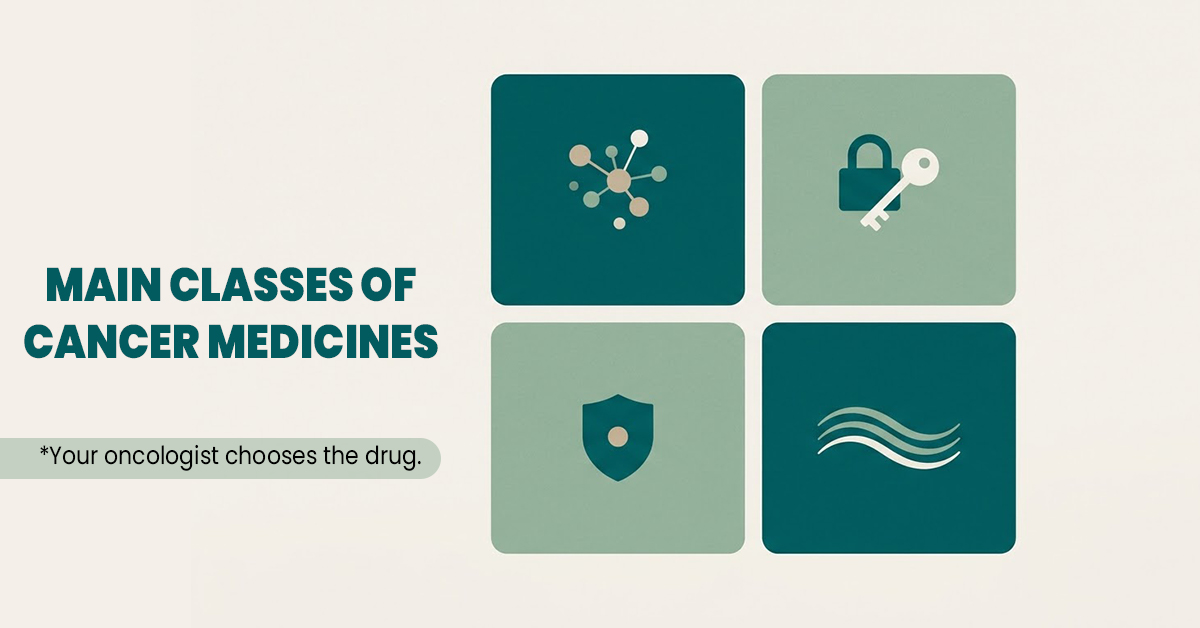
Quick answer: A cancer medicine name list groups drugs by how they work, not by brand. The main classes are chemotherapy, targeted therapy, immunotherapy and hormonal therapy. Each drug has one generic name and many brand names. Your oncologist selects the drug based on cancer type, stage and laboratory test results.
The main classes of anti-cancer medicines
|
Class |
How it works |
Example generic names (educational only) |
|
Chemotherapy: alkylating and platinum agents |
Damages DNA in rapidly dividing cells |
Cyclophosphamide, cisplatin, carboplatin |
|
Chemotherapy: antimetabolites |
Interferes with cell building blocks |
Methotrexate, 5-fluorouracil, capecitabine |
|
Chemotherapy: taxanes and anthracyclines |
Blocks cell division or damages DNA |
Paclitaxel, docetaxel, doxorubicin |
|
Targeted therapy: small molecules |
Blocks specific signals that drive some cancers |
Imatinib, erlotinib |
|
Targeted therapy: monoclonal antibodies |
Binds specific proteins on cancer cells |
Trastuzumab, rituximab |
|
Immunotherapy: checkpoint inhibitors |
Helps the immune system recognise cancer cells |
Pembrolizumab, nivolumab, durvalumab |
|
Hormonal therapy |
Blocks or lowers hormones that feed some cancers |
Tamoxifen, letrozole, anastrozole |
Examples show how drugs are grouped. Which drug suits which cancer is a medical decision for your oncologist.
Generic, brand and biosimilar: what is the difference?
A generic medicine has the same active ingredient, strength and dosage form as an originator drug. A brand is the commercial name a company gives it. A biosimilar is a highly similar version of a biologic drug, such as an antibody. Biosimilars are not identical, because biologics are made in living cells.
Never start, stop or switch a cancer medicine because of a list. Switching brands or biosimilars should happen only with your oncologist’s agreement. Doses, delivery devices and storage needs can differ.
To see which cancer medicines India treats as essential, ask your hospital pharmacy about the National List of Essential Medicines (NLEM). Medicines on this list are subject to government ceiling prices.
Questions to ask your oncologist about your medicines
- What is the generic name of each medicine, and what does it do?
- Is a lower-priced generic or biosimilar suitable for me?
- Is this medicine covered by PM-JAY or my insurance policy?
- Does the hospital pharmacy stock it, or must I buy outside?
- What side effects should I report, and to whom?
- How should I store it at home, and for how long?
- Which supplements, herbal products or foods should I avoid or discuss first?
- What should I do if a dose is missed or a pack looks damaged?
Write the answers down. Ask a family member to join the visit if you can. Clear answers reduce the risk of dosing mistakes and avoidable costs.
3. How Are Cancer Medicine Prices Set and Capped in India?
A fixed “cancer medicine price list” can mislead, because prices change when regulators revise them. India now uses three tools: ceiling prices for scheduled drugs, trade margin caps for others, and tax and duty relief. Each acts on a different part of the price a patient pays at the counter.
Quick answer: The NPPA controls cancer medicine prices in two ways. It fixes ceiling prices for scheduled anti-cancer drugs. It also caps the trade margin, the gap between manufacturer price and retail price, at 30% for listed non-scheduled drugs. In October 2026, that cap was extended to 137 drugs.
A short timeline of price relief
|
When |
Measure |
What changed |
|
2019 |
Trade margin cap pilot |
NPPA capped trade margins at 30% on 42 non-scheduled anti-cancer drugs. Reported maximum retail price (MRP) reductions reached up to 90% across 526 brands. |
|
February 2025 |
Union Budget 2025–26 |
36 life-saving drugs were fully exempted from basic customs duty, and six more got a 5% concessional duty. Cancer drugs were among them. |
|
22 September 2025 |
GST Council decision |
GST on 33 life-saving drugs was cut from 12% to nil. Most other medicines moved to a 5% rate. |
|
October to 9 November 2026 |
Trade margin cap extended |
How the 30% trade margin cap works
Trade margin is the difference between the price at which a manufacturer sells to distributors and the final retail price. Under the cap, a formulation with a stockist price of ₹70 can have a maximum revised MRP of ₹100, before GST (Upstox, 2026). The manufacturer’s own selling price is not what the cap targets. The cap targets the mark-up after it.
The government told Parliament that the NPPA has also fixed ceiling prices for scheduled anti-cancer formulations under the NLEM (Biovoice, 2025). Not every cancer drug is covered yet. New and patented drugs often sit outside these caps.
Why printed price lists go out of date
A price list copied from a website in October 2026 does not reflect the 9 November revision. Prices also differ by brand, strength, pack size and city. Use these steps instead:
- Ask your oncologist for the generic name of every medicine on your prescription.
- Ask the pharmacist for the current MRP and the batch number. Compare it with the price on the pack.
- Check the NPPA website for the latest ceiling-price and price-revision notices.
- Report suspected overcharging to the NPPA through its public complaint channel.
How to read a cancer medicine pack
A pack carries most of the information you need to judge a price or spot a problem. Check these details every time you collect a medicine:
- Generic name and strength: This must match your prescription exactly.
- Brand and manufacturer: The licence number and address of the manufacturer should be printed.
- MRP: The maximum retail price includes taxes. A pharmacy should not charge more.
- Batch number and dates: Check the manufacturing and expiry dates, and note the batch for any complaint.
- Storage line: Words such as “store at 2–8°C” mean the product must stay refrigerated.
- Seal and packaging: Reject packs that are torn, leaking or relabelled.
For example, suppose a drug’s stockist price is ₹70. Under the 30% cap, its revised MRP can be at most ₹100, before GST. If a pack shows a much higher MRP after the revision date, ask the pharmacist why, and report it to the NPPA if the answer is unclear.
What the price cap does not change
The cap lowers the mark-up on listed drugs. It does not change what your oncologist prescribes, and it does not cover every cancer medicine. Newer patented drugs, hospital procedure charges, scans, and consultation fees fall outside it. Your total cost depends on the whole treatment plan, not on one medicine’s price.
The cap also depends on each manufacturer recalculating its MRP. Some old stock may still show the earlier price for a short time. If you see two prices for the same batch, ask the pharmacist which applies, and keep the bill.
4. Is There Free Cancer Medicine in India? Schemes You Can Check
Free cancer medicine in India exists, but it is not universal. Most free support comes through government hospitals, insurance schemes and relief funds. Eligibility depends on income, location and where you are treated. Knowing the schemes lets you ask the right questions on day one.
Quick answer: Free cancer medicine in India is available through schemes such as Ayushman Bharat PM-JAY, the Health Minister’s Cancer Patient Fund and Rashtriya Arogya Nidhi, plus Jan Aushadhi discounts and state programmes. Eligibility depends on income, residence and the hospital. Ask your hospital’s medical social worker which scheme applies to you.
Ayushman Bharat PM-JAY
PM-JAY offers cashless cover of up to ₹5 lakh per family per year at empanelled hospitals. The Ministry of Health has told Parliament that cancer treatment is covered under oncology packages for medical, surgical and radiation care (Rajya Sabha reply, 2024). Ask the hospital’s Ayushman Mitra desk to check your eligibility.
Health Minister’s Cancer Patient Fund and Rashtriya Arogya Nidhi
The Health Minister’s Cancer Patient Fund (HMCPF) is part of the Rashtriya Arogya Nidhi (RAN) umbrella scheme. It gives financial assistance to eligible poor patients treated at designated Regional Cancer Centres and government institutions. Funds are released to the treating hospital, not to the patient. Reimbursement of money already spent is generally not allowed.
Published assistance ceilings differ between sources. A PIB document from February 2025 mentions aid of up to ₹5 lakh, while some reports cite higher limits. Confirm the current figure with the hospital or the Ministry of Health and Family Welfare before you plan around it.
Jan Aushadhi and AMRIT pharmacies
The Pradhan Mantri Bhartiya Janaushadhi Pariyojana runs Jan Aushadhi Kendras that sell quality generics at lower prices. Government statements describe discounts of roughly 50% to 80% below market rates. AMRIT pharmacies at some government hospitals also sell cancer medicines at discounts. Not every cancer drug is stocked, so ask in advance.
State schemes, relief funds and day-care centres
- State schemes: Maharashtra’s Mahatma Jyotiba Phule Jan Arogya Yojana, Tamil Nadu’s CMCHIS and West Bengal’s Swasthya Sathi are examples. Rules differ by state.
- Relief funds: The Prime Minister’s National Relief Fund and state Chief Minister’s Relief Funds consider case-by-case requests.
- Patient assistance programmes: Budget 2025 exempted medicines supplied free under approved company patient assistance programmes from basic customs duty. Ask your oncologist whether a programme exists for your drug.
- Day-care cancer centres: The government announced day-care cancer centres in all district hospitals over three years, starting with 200 in 2025–26. These bring chemotherapy closer to home.
What to bring when you apply: Aadhaar, ration or income documents, the diagnosis report, the treatment estimate and the hospital’s letter. The medical social services department at most government cancer centres can guide you through the forms.
Why applications get delayed, and how to avoid it
- Missing documents: Keep several photocopies of the diagnosis report, estimate, identity proof and income or ration proof.
- Wrong hospital: Many schemes work only at empanelled or designated centres. Check this before you start treatment.
- Paying first: Schemes such as RAN and HMCPF generally do not reimburse money already spent. Apply before the treatment cost is incurred.
- Card or eligibility issues: Confirm that your Ayushman card is active and that family details match your documents.
- One-time limits: RAN and HMCPF assistance is generally a one-time grant, so ask the hospital how to plan the whole course of treatment.
Most large government cancer centres have a medical social worker or a scheme help desk. Ask for them at your first visit, not after the bills arrive.
What free treatment usually covers, and what it does not
Cashless schemes typically cover admission, surgery, chemotherapy, radiotherapy and some diagnostics at empanelled hospitals. They often do not cover travel, lodging for family, outside medicines the hospital does not stock, or supplements. Ask for a written list of what is covered before you begin.
If your hospital does not stock a medicine, ask whether a nearby Jan Aushadhi Kendra or AMRIT pharmacy does. Also ask whether your oncologist can prescribe an equivalent from the hospital’s own stock.
5. How Can You Buy Cancer Medicines Safely and Compare Options?
Safe buying matters as much as price. Cancer injectables and biologics need correct storage, and counterfeit medicines are a real risk in any market. A few simple checks protect you, whichever company makes the medicine.
Quick answer: To buy cancer medicines safely, use a valid prescription and a licensed pharmacy. Check the batch number, expiry date and seal. Keep injectables in the cold chain the label requires. Compare the price with the MRP on the pack. Never switch brands without your oncologist’s agreement.
- Prescription first. Anti-cancer drugs are prescription medicines. Never buy them from an unverified seller or social media page.
- Licensed pharmacy. Ask for a proper bill showing the drug name, batch and expiry. Keep it for insurance claims.
- Cold chain. Many biologics and some injectables need refrigeration. Reject a pack that has travelled unrefrigerated.
- Price check. Compare the amount charged with the MRP printed on the pack, and with the NPPA revision notices.
- Hospital pharmacy. Ask whether the hospital pharmacy or a Jan Aushadhi outlet stocks the generic version.
- Brand or biosimilar change. Ask your oncologist before any switch, and ask why they chose that product.
Common myths about cancer medicine prices and companies
- “A higher price means a better drug.” Price reflects patents, margins and supply costs. It does not measure how well a medicine will work for you.
- “Generic medicines are lower quality.” Generics must meet regulatory standards for active ingredient and strength. Quality problems usually come from poor supply chains, not from the generic label.
- “A top-company list tells me what to buy.” Only your oncologist can match a drug to your cancer, stage and test results.
- “Free medicine means second-rate medicine.” Products supplied through government hospitals must still be licensed. Ask for batch details if you have doubts.
- “One price list works for every city.” Prices vary by brand, pack and revision date. Check the pack and the NPPA notices.
6. Where Does Ayurvedic Supportive Care Fit Alongside Oncology Medicines?
Many patients and caregivers ask about Ayurveda during cancer treatment. The honest answer is that it can offer supportive care for comfort and wellbeing. It does not replace surgery, chemotherapy, radiotherapy or any medicine your oncologist prescribes. Every supplement needs your oncologist’s knowledge first.
Quick answer: Ayurvedic supportive care is complementary care used alongside, never instead of, oncology treatment. It focuses on comfort, nutrition and everyday wellbeing during treatment. It does not treat or cure cancer. Patients should tell their oncologist about every herbal product before starting it, because some can interact with cancer drugs.
Health Reactive was established in 1996 and is an ISO/GMP-certified, AYUSH-registered Ayurvedic manufacturer. Our flagship product, Body Revival, is a nine-herb Ayurvedic liquid formulation positioned as complementary supportive care. It is not a cancer treatment.
Body Revival has a registered clinical study: CTRI/2023/11/059465, a 44-patient, 12-week, open-label study in post-surgical patients at J.B. Roy State Ayurvedic Medical College & Hospital, Kolkata. The study completed in November 2024. It is registered but not yet peer-reviewed, and it applies only to the specific post-surgical group studied. It is not evidence for any other condition.
If you are a patient or caregiver who wants to understand supportive-care options that sit alongside your oncology plan, our team can talk you through them. For related reading, see our guides on Ayurveda alongside chemotherapy: a safety guide, managing chemotherapy side effects, and questions to ask before chemotherapy.
Questions to ask before adding any supportive product
- Has my oncologist been told the full ingredient list?
- Is the product made by a licensed manufacturer, and does the label show a batch and expiry date?
- Does it make any cure or treatment claim? If it does, that is a warning sign.
- Will it be taken at a different time from my cancer medicines, and does my oncologist agree?
- What should I stop and report if I notice a new symptom?
What Experts and Experience Add to This Picture
Expert perspective. Kiran Mazumdar-Shaw, CMD of Biocon, welcomed the 2025 customs duty exemption on 36 life-saving drugs, saying it would improve access to imported drugs. She also praised the plan for district day-care cancer centres (Biovoice, 2025). Her view shows that access, not only price, shapes cancer care in India.
Our original insight. In supportive-care consultations, caregivers often ask first about cost, and then about whether two brands on a prescription are really the same medicine. A clear conversation with the oncologist about generic names settles most of these doubts before money is spent.
Frequently Asked Questions
No regulator names a best company. Sun Pharma, Dr. Reddy’s, Cipla, Zydus, Natco, Intas and Biocon are often cited. The right medicine depends on your cancer, and your oncologist decides it.
Some is. PM-JAY, the Health Minister’s Cancer Patient Fund, Rashtriya Arogya Nidhi and state schemes can cover treatment for eligible patients. Eligibility depends on income, residence and hospital, so ask the hospital’s medical social worker.
Use the NPPA website for ceiling prices and revision notices, and check the MRP on the pack. Avoid copied price lists, because the 9 November 2026 revision made many of them outdated.
Generics contain the same active ingredient and strength as the originator and must meet CDSCO standards. Differences can exist in packaging or delivery devices. Ask your oncologist before changing any brand.
It limits the mark-up between the manufacturer’s price and the retail price on 137 listed drugs. Retail prices are expected to fall. Not every cancer medicine is covered, so check your own drug.
Only after your oncologist agrees. Some herbal products can interact with cancer drugs. Ayurvedic supportive care is complementary. It is not a replacement for your oncology treatment.
The top cancer drug companies in India include major generics makers and global originators, but no official ranking exists. Three points matter most. Prices are changing, so check the current MRP rather than an old list. Free help exists through PM-JAY, relief funds, Jan Aushadhi and state schemes. And your oncologist, not a list, decides which medicine is right for you.
Talk to Us
If you or someone you care for is going through cancer treatment and want to understand complementary supportive-care options alongside your oncology plan, speak to our team.
Book a Free Consultation → healthreactive.co/bodyrevival
About the author and reviewer: Dr. Hemant Kadam is a BAMS practitioner with more than 10 years of experience. Dr. Farah Zariwala is a BHMS with more than 10 years of experience in Ayurveda and Homeopathy and serves as Medical Reviewer for Health Reactive’s cancer-support content.